Identify Major Organic Products Q R and S in Multi Step Reaction Sequence
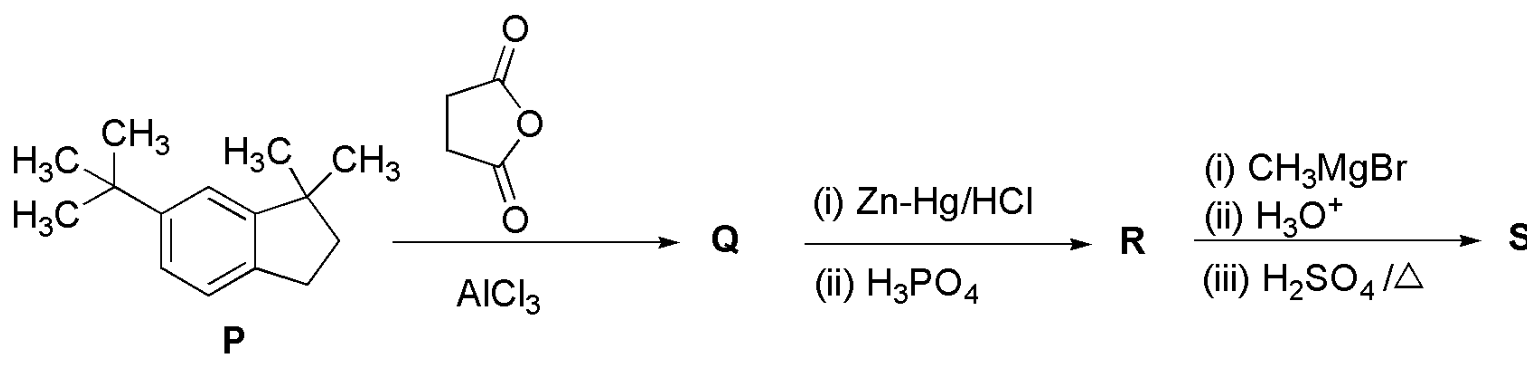
Consider the reaction scheme depicted below, where , , and represent the major organic products.
Options
is
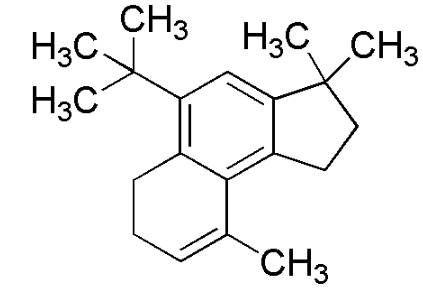
is
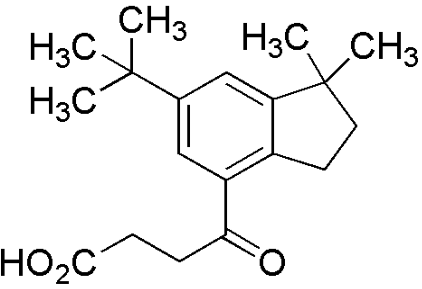
is
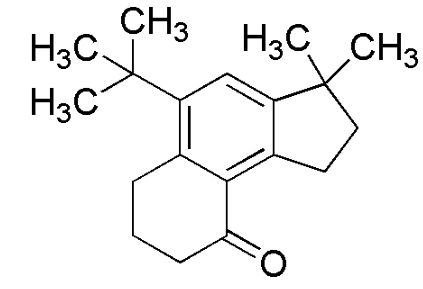
is
Step-by-Step Solution
To determine the correct structures of the major organic products , , and , we analyze the multi-step reaction sequence step by step:
Step 1: Formation of Product
- Reaction: Compound is subjected to Friedel-Crafts acylation using succinic anhydride in the presence of Lewis acid .
- Regioselectivity: Compound contains an aromatic ring substituted with a bulky tert-butyl group and a fused five-membered ring having a gem-dimethyl group at one benzylic position and a methylene group at the other. Electrophilic aromatic substitution occurs at the position that is least sterically hindered (ortho to the less bulky group of the indan ring).
- Product: The electrophilic attack of succinic anhydride yields a keto-acid: This matches the structure shown in Option (B).
Step 2: Formation of Product
-
Step (i) - Clemmensen Reduction (): The keto-acid undergoes reduction of the aryl ketone group () to a methylene group (), giving the 4-arylbutanoic acid intermediate:
-
Step (ii) - Intramolecular Friedel-Crafts Acylation (): Heating with phosphoric acid () promotes intramolecular cyclization of the carboxylic acid onto the adjacent open position of the benzene ring, forming a new six-membered ring fused to the aromatic core. The carbonyl group formed is located at the benzylic position: This matches the structure shown in Option (C).
Step 3: Formation of Product
-
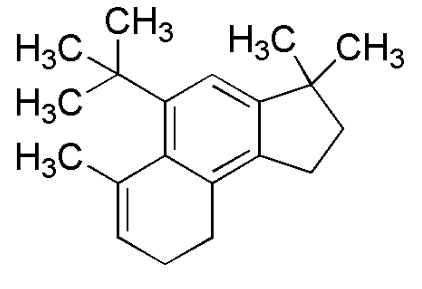
Step (i) & (ii) - Grignard Addition and Acidic Workup (, then ): Methylmagnesium bromide () undergoes nucleophilic addition to the carbonyl group of tetralone . Subsequent acidic workup yields a tertiary benzylic alcohol bearing a methyl group at the reaction site:
-
Step (iii) - Acid-Catalyzed Dehydration (): Protonation of the tertiary alcohol followed by loss of a water molecule generates a stable benzylic carbocation. Elimination of a proton gives the thermodynamically favored, highly stable endocyclic alkene conjugated with the aromatic ring, which retains the methyl group attached to the double bond:
This matches the structure shown in Option (A), while Option (D) is incorrect because it omits the methyl group introduced by the Grignard reagent.
Conclusion:
The correct options are A, B, and C.