Acidity Comparison and Aromaticity of Cyclic and Aromatic Hydrocarbons
Consider the organic structures labeled I through V. Choose the correct statement(s) from the options below.
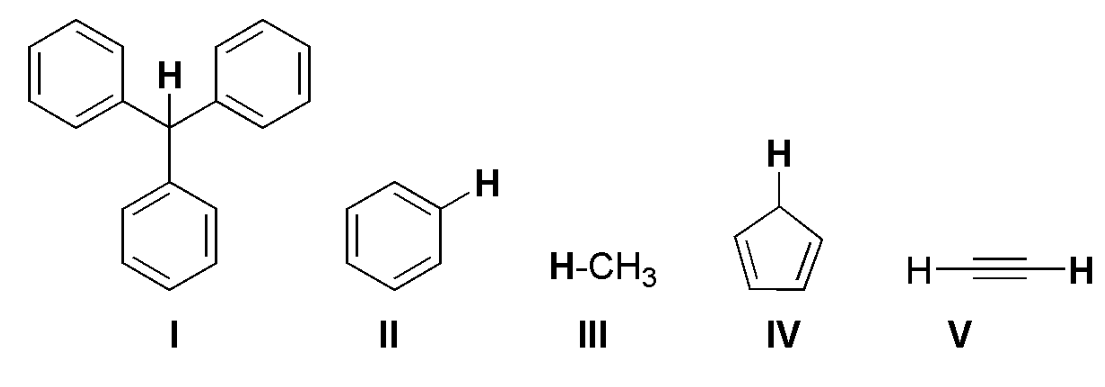
Options
The enhanced acidity of structure I stems from delocalization of charge in its conjugate base.
The conjugate base derived from compound IV exhibits aromatic character.
Introducing a substituent onto compound II increases its acidity.
The relative acidity of the compounds follows the sequence I > IV > V > II > III.
Step-by-Step Solution
To determine the correct statement(s), let us analyze the given compounds and their structural properties:
- I: Triphenylmethane,
- II: Benzene,
- III: Methane,
- IV: Cyclopentadiene,
- V: Acetylene,
Step-by-Step Analysis of Options:
-
Option A: "The acidity of compound I is due to delocalization in the conjugate base."
- Deprotonation of triphenylmethane (I) gives the triphenylmethyl carbanion .
- The negative charge on the central carbon atom is stabilized by resonance delocalization across the -systems of the three attached phenyl rings.
- This extensive resonance stabilization significantly increases the acidity of compound I compared to aliphatic alkanes.
- Statement A is correct.
-
Option B: "The conjugate base of compound IV is aromatic."
- Deprotonation of cyclopentadiene (IV) at the hybridized methylene carbon gives the cyclopentadienyl anion .
- The cyclopentadienyl anion is cyclic, planar, fully conjugated, and contains -electrons.
- According to Hückel's rule electrons (with ), this anion is aromatic, conferring extra stability.
- Statement B is correct.
-
Option C: "Compound II becomes more acidic, when it has a substituent."
- Compound II is benzene.
- The nitro group () is a strong electron-withdrawing group via both inductive () and resonance () effects.
- The presence of a substituent stabilizes the carbanionic conjugate base formed upon deprotonation, thereby increasing the acidity relative to unsubstituted benzene.
- Statement C is correct.
-
Option D: "The acidity of compounds follows the order I > IV > V > II > III."
- Let us compare the values of the compounds:
- IV (Cyclopentadiene): (stabilized by aromaticity in conjugate base)
- V (Acetylene): (-hybridized C-H bond, high -character)
- I (Triphenylmethane): (resonance delocalization across three phenyl rings)
- II (Benzene): (-hybridized C-H bond)
- III (Methane): (-hybridized C-H bond)
- Therefore, the correct relative acidity order (decreasing order of acidity) is:
- Option D incorrectly states the order as .
- Statement D is incorrect.
- Let us compare the values of the compounds:
Conclusion:
The correct statements are A, B, and C.