Identification of Non Reducing Disaccharide Structure Giving Laevorotatory Hydrolysis Product
A disaccharide cannot be oxidised by bromine water. The acid hydrolysis of leads to a laevorotatory solution. The disaccharide is
Options
Topics & Concepts
Step-by-Step Solution
To determine the identity of the disaccharide , we analyze its chemical properties step-by-step:
1. Reaction with Bromine Water (Non-reducing Sugar)
Bromine water () is a mild oxidizing agent that selectively oxidizes aldoses (free aldehyde or hemiacetal groups) to aldonic acids. Since disaccharide cannot be oxidized by bromine water, it lacks a free hemiacetal or hemiketal group at its anomeric carbons.
This indicates that is a non-reducing disaccharide, where the anomeric carbons of both monosaccharide units are mutually involved in the glycosidic linkage.
2. Acid Hydrolysis and Optical Rotation
Upon acid hydrolysis, yields an equimolar mixture of its constituent monosaccharides:
- The specific rotation of is .
- The specific rotation of is .
The net specific rotation of the hydrolyzed equimolar mixture (invert sugar) is calculated as:
Since the resulting mixture is laevorotatory (a process known as the inversion of sugar), the disaccharide must be sucrose.
3. Structural Analysis of Sucrose
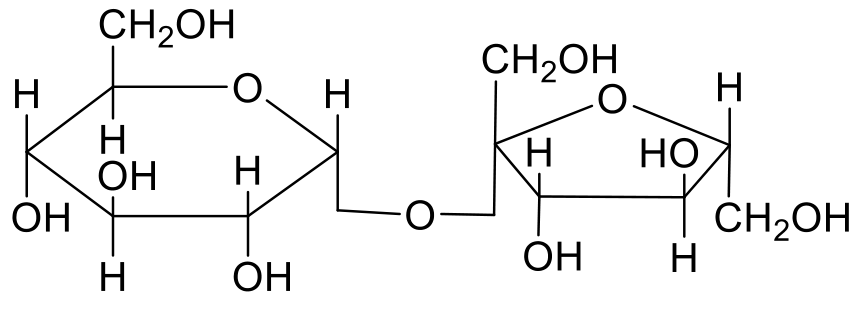
Sucrose is composed of an -D-glucopyranose unit and a -D-fructofuranose unit connected by a glycosidic linkage:
- Left Unit (-D-glucopyranose): A 6-membered pyranose ring with the glycosidic oxygen attached at in the -configuration (pointing downwards in Haworth projection).
- Right Unit (-D-fructofuranose): A 5-membered furanose ring with the glycosidic oxygen attached at its anomeric carbon .
Comparing the given options:
- Option (A): Correctly shows the glycosidic linkage between -D-glucopyranose and -D-fructofuranose without any free hemiacetal/hemiketal group.
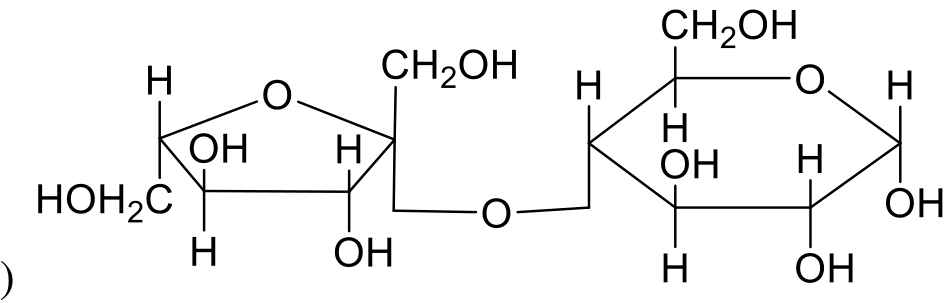
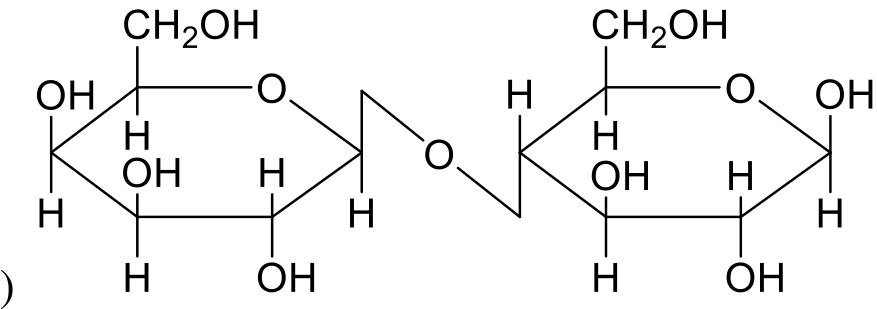
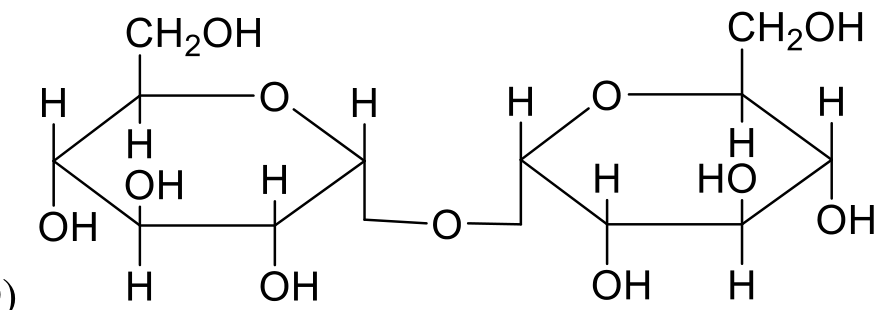
- Options (B), (C), and (D): Represent reducing disaccharides with free hemiacetal OH groups at anomeric centers.
Thus, the correct structure of disaccharide is given by (A).