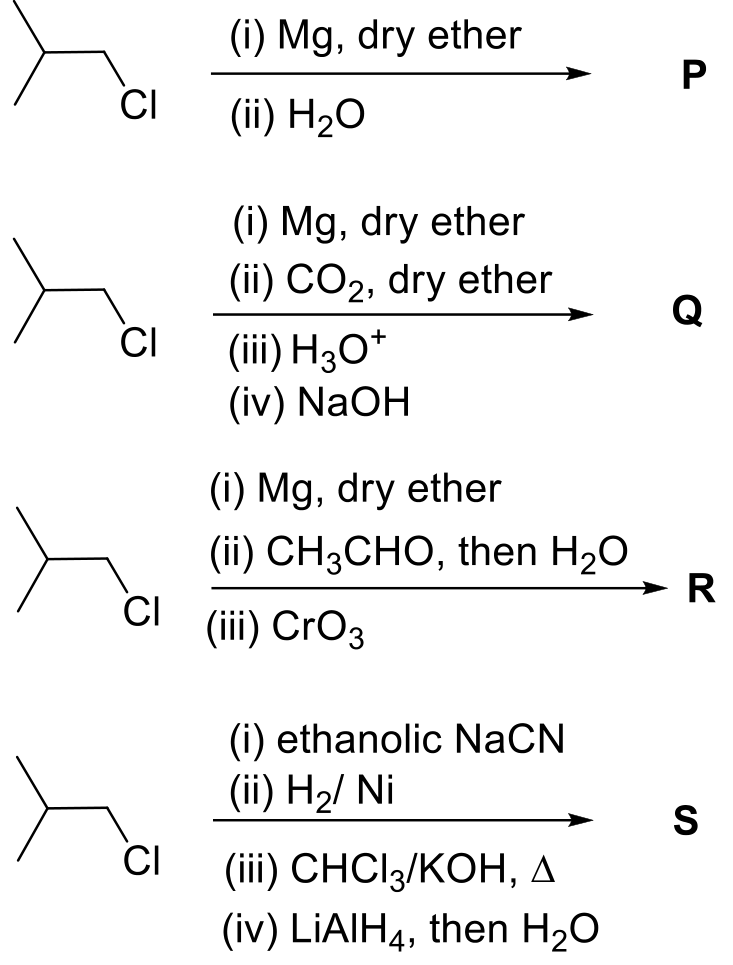
To determine the correct statement, we analyze the reaction steps to identify products P \mathbf{P} P Q \mathbf{Q} Q R \mathbf{R} R S \mathbf{S} S
The starting compound in all the reaction sequences is isobutyl chloride (1-chloro-2-methylpropane), ( C H 3 ) 2 C H C H 2 C l (CH_3)_2CHCH_2Cl ( C H 3 ) 2 C H C H 2 C l
1. Formation and Analysis of Product P \mathbf{P} P
Grignard Reagent Formation:
( C H 3 ) 2 C H C H 2 C l + Mg → dry ether ( C H 3 ) 2 C H C H 2 M g C l (CH_3)_2CHCH_2Cl + \text{Mg} \xrightarrow{\text{dry ether}} (CH_3)_2CHCH_2MgCl ( C H 3 ) 2 C H C H 2 C l + Mg dry ether ( C H 3 ) 2 C H C H 2 M g C l Protonation (Hydrolysis):
( C H 3 ) 2 C H C H 2 M g C l + H 2 O → ( C H 3 ) 2 C H C H 3 + Mg(OH)Cl (CH_3)_2CHCH_2MgCl + \text{H}_2\text{O} \rightarrow (CH_3)_2CHCH_3 + \text{Mg(OH)Cl} ( C H 3 ) 2 C H C H 2 M g C l + H 2 O → ( C H 3 ) 2 C H C H 3 + Mg(OH)Cl
Product P \mathbf{P} P isobutane (2-methylpropane), which is an alkane containing 4 carbons, not an alcohol.
Thus, Option A is incorrect .
2. Formation and Analysis of Product Q \mathbf{Q} Q
Grignard Addition to CO 2 \text{CO}_2 CO 2
( C H 3 ) 2 C H C H 2 M g C l + CO 2 → dry ether ( C H 3 ) 2 C H C H 2 C O O M g C l (CH_3)_2CHCH_2MgCl + \text{CO}_2 \xrightarrow{\text{dry ether}} (CH_3)_2CHCH_2COOMgCl ( C H 3 ) 2 C H C H 2 M g C l + CO 2 dry ether ( C H 3 ) 2 C H C H 2 C O O M g C l
Acid Hydrolysis:
( C H 3 ) 2 C H C H 2 C O O M g C l → H 3 O + ( C H 3 ) 2 C H C H 2 C O O H (3-methylbutanoic acid) (CH_3)_2CHCH_2COOMgCl \xrightarrow{\text{H}_3\text{O}^+} (CH_3)_2CHCH_2COOH \quad \text{(3-methylbutanoic acid)} ( C H 3 ) 2 C H C H 2 C O O M g C l H 3 O + ( C H 3 ) 2 C H C H 2 C O O H (3-methylbutanoic acid)
Neutralization:
( C H 3 ) 2 C H C H 2 C O O H + NaOH → ( C H 3 ) 2 C H C H 2 C O O N a + H 2 O (CH_3)_2CHCH_2COOH + \text{NaOH} \rightarrow (CH_3)_2CHCH_2COONa + \text{H}_2\text{O} ( C H 3 ) 2 C H C H 2 C O O H + NaOH → ( C H 3 ) 2 C H C H 2 C O O N a + H 2 O Q \mathbf{Q} Q sodium 3-methylbutanoate .
Kolbe's Electrolysis of Q \mathbf{Q} Q
During Kolbe's electrolysis, carboxylate ions undergo oxidative decarboxylation at the anode to generate alkyl radicals, which then dimerize:
2 ( C H 3 ) 2 C H C H 2 C O O N a → electrolysis ( C H 3 ) 2 C H C H 2 − C H 2 C H ( C H 3 ) 2 + 2 CO 2 + 2 e − + 2 Na + 2(CH_3)_2CHCH_2COONa \xrightarrow{\text{electrolysis}} (CH_3)_2CHCH_2-CH_2CH(CH_3)_2 + 2\text{CO}_2 + 2 e^- + 2\text{Na}^+ 2 ( C H 3 ) 2 C H C H 2 C O O N a electrolysis ( C H 3 ) 2 C H C H 2 − C H 2 C H ( C H 3 ) 2 + 2 CO 2 + 2 e − + 2 Na + 2,5-dimethylhexane , an eight-carbon alkane (C 8 H 18 \text{C}_8\text{H}_{18} C 8 H 18
Thus, Option B is correct .
3. Formation and Analysis of Product R \mathbf{R} R
Nucleophilic Addition to Acetaldehyde:
( C H 3 ) 2 C H C H 2 M g C l + CH 3 CHO → then H 2 O ( C H 3 ) 2 C H C H 2 − C H ( O H ) − C H 3 (4-methylpentan-2-ol) (CH_3)_2CHCH_2MgCl + \text{CH}_3\text{CHO} \xrightarrow{\text{then }\text{H}_2\text{O}} (CH_3)_2CHCH_2-CH(OH)-CH_3 \quad \text{(4-methylpentan-2-ol)} ( C H 3 ) 2 C H C H 2 M g C l + CH 3 CHO then H 2 O ( C H 3 ) 2 C H C H 2 − C H ( O H ) − C H 3 (4-methylpentan-2-ol) Oxidation:
( C H 3 ) 2 C H C H 2 − C H ( O H ) − C H 3 → CrO 3 ( C H 3 ) 2 C H C H 2 − C O − C H 3 (4-methylpentan-2-one) (CH_3)_2CHCH_2-CH(OH)-CH_3 \xrightarrow{\text{CrO}_3} (CH_3)_2CHCH_2-CO-CH_3 \quad \text{(4-methylpentan-2-one)} ( C H 3 ) 2 C H C H 2 − C H ( O H ) − C H 3 CrO 3 ( C H 3 ) 2 C H C H 2 − C O − C H 3 (4-methylpentan-2-one)
Product R \mathbf{R} R ketone containing 6 carbon atoms and α \alpha α α \alpha α cannot undergo the Cannizzaro reaction (which is given by non-enolizable aldehydes).
Thus, Option C is incorrect .
4. Formation and Analysis of Product S \mathbf{S} S
Nitrile Synthesis:
( C H 3 ) 2 C H C H 2 C l + NaCN → ethanol ( C H 3 ) 2 C H C H 2 C N + NaCl (CH_3)_2CHCH_2Cl + \text{NaCN} \xrightarrow{\text{ethanol}} (CH_3)_2CHCH_2CN + \text{NaCl} ( C H 3 ) 2 C H C H 2 C l + NaCN ethanol ( C H 3 ) 2 C H C H 2 C N + NaCl Reduction to Primary Amine:
( C H 3 ) 2 C H C H 2 C N → H 2 / Ni ( C H 3 ) 2 C H C H 2 C H 2 N H 2 (3-methylbutan-1-amine) (CH_3)_2CHCH_2CN \xrightarrow{\text{H}_2/\text{Ni}} (CH_3)_2CHCH_2CH_2NH_2 \quad \text{(3-methylbutan-1-amine)} ( C H 3 ) 2 C H C H 2 C N H 2 / Ni ( C H 3 ) 2 C H C H 2 C H 2 N H 2 (3-methylbutan-1-amine) Carbylamine Reaction:
( C H 3 ) 2 C H C H 2 C H 2 N H 2 + CHCl 3 + 3 KOH → Δ ( C H 3 ) 2 C H C H 2 C H 2 N C + 3 KCl + 3 H 2 O (CH_3)_2CHCH_2CH_2NH_2 + \text{CHCl}_3 + 3\text{KOH} \xrightarrow{\Delta} (CH_3)_2CHCH_2CH_2NC + 3\text{KCl} + 3\text{H}_2\text{O} ( C H 3 ) 2 C H C H 2 C H 2 N H 2 + CHCl 3 + 3 KOH Δ ( C H 3 ) 2 C H C H 2 C H 2 N C + 3 KCl + 3 H 2 O Reduction of Isocyanide:
( C H 3 ) 2 C H C H 2 C H 2 N C → ( 1 ) LiAlH 4 , ( 2 ) H 2 O ( C H 3 ) 2 C H C H 2 C H 2 N H C H 3 (CH_3)_2CHCH_2CH_2NC \xrightarrow{(1) \text{LiAlH}_4, (2) \text{H}_2\text{O}} (CH_3)_2CHCH_2CH_2NHCH_3 ( C H 3 ) 2 C H C H 2 C H 2 N C ( 1 ) LiAlH 4 , ( 2 ) H 2 O ( C H 3 ) 2 C H C H 2 C H 2 N H C H 3
Product S \mathbf{S} S N , 3 N,3 N , 3 secondary amine containing 6 carbon atoms (not a primary amine).
Thus, Option D is incorrect .
Conclusion: The correct statement is B .