Identification of Metal Ion M1 and Ligand Reagents
An aqueous solution of metal ion reacts separately with reagents and in excess to give tetrahedral and square planar complexes, respectively. An aqueous solution of another metal ion consistently forms tetrahedral complexes with these reagents. The reaction of an aqueous solution of with reagent yields a white precipitate which subsequently dissolves in an excess of . These transformations are summarized in the scheme below:
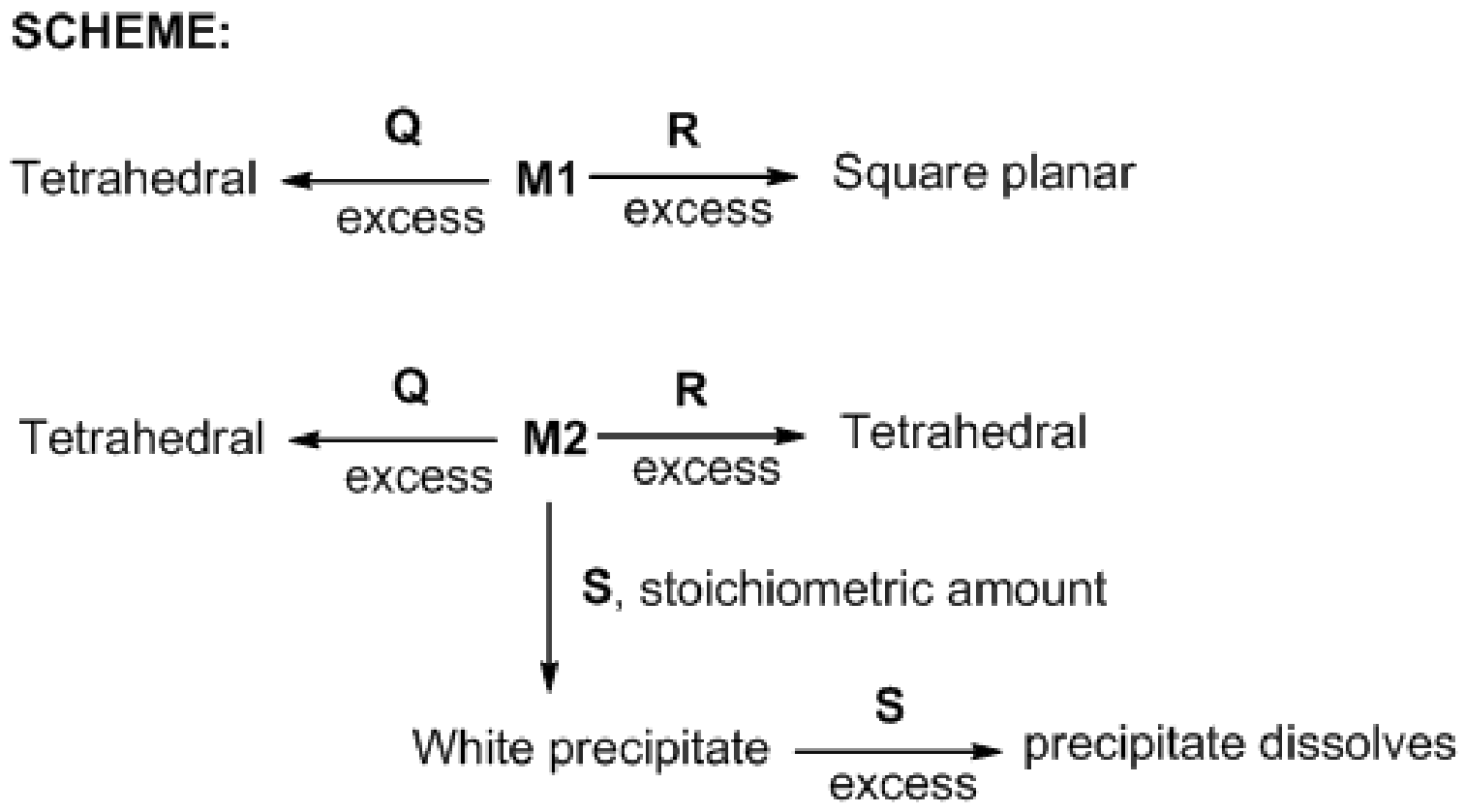
Identify , , and , respectively:
Options
, and
, and
, and
, , and
Step-by-Step Solution
To determine the identities of , , and , we analyze the coordination chemistry and stereochemistry of the metal complexes described in the passage:
-
Reaction of with excess and :
- With excess reagent , the metal ion forms a tetrahedral complex.
- With excess reagent , the metal ion forms a square planar complex.
-
Analysis of Metal Ions:
-
For ( configuration):
- With a weak field ligand like (provided by excess ), pairing of electrons does not occur. The complex formed is , which undergoes hybridization and possesses a tetrahedral geometry:
- With a strong field ligand like (provided by excess ), pairing of the two unpaired electrons occurs, vacating one orbital. The complex formed is , which undergoes hybridization and possesses a square planar geometry:
-
For other given ions:
- and ( configurations) have completely filled -orbitals, so they universally form tetrahedral complexes () with both weak and strong field 4-coordinate ligands (e.g., both and are tetrahedral). This identifies as , not .
- () typically forms tetrahedral complexes with , but with excess , it oxidizes readily to form low-spin octahedral complexes such as or five-/six-coordinate complexes.
-
-
Conclusion:
- Metal ion
- Reagent
- Reagent
Therefore, the correct option is B.