Identification of Major Products in a Multi-step Organic Synthesis
Select the correct option(s) corresponding to the products formed in the following reaction sequence:
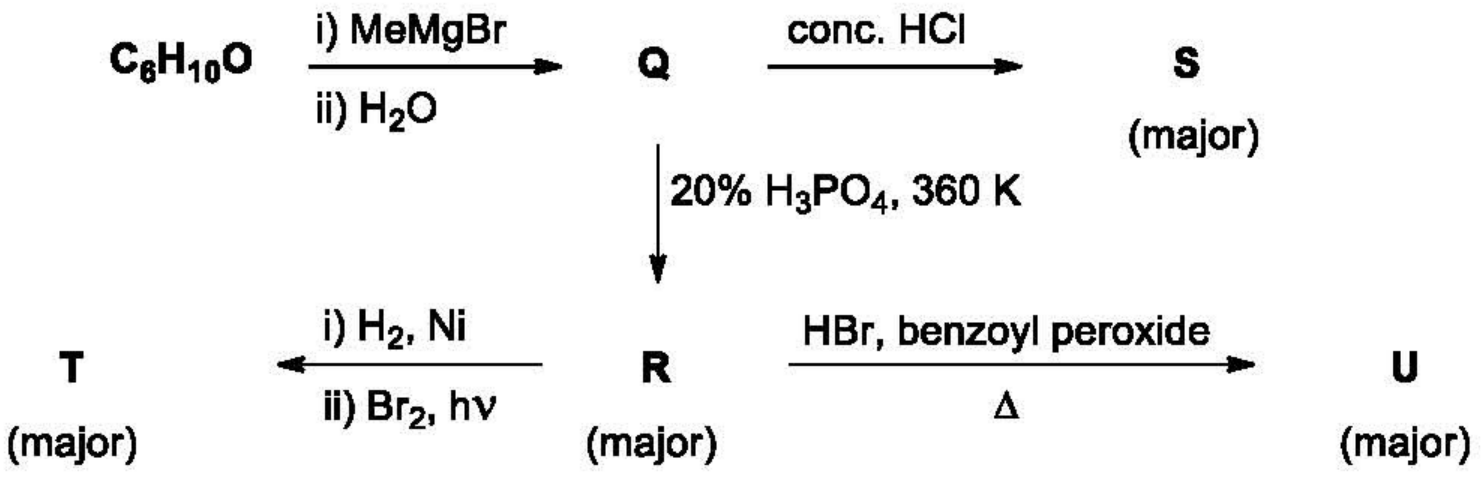
Options
A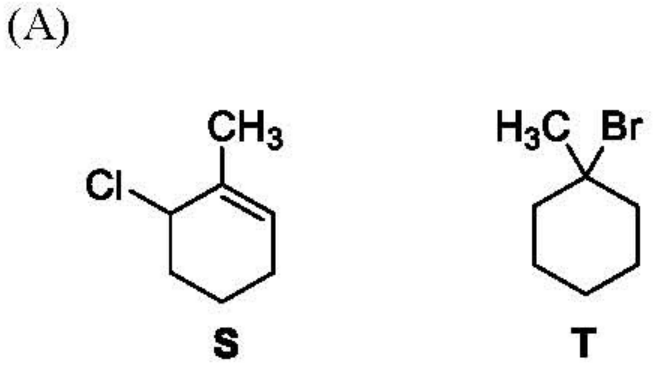
B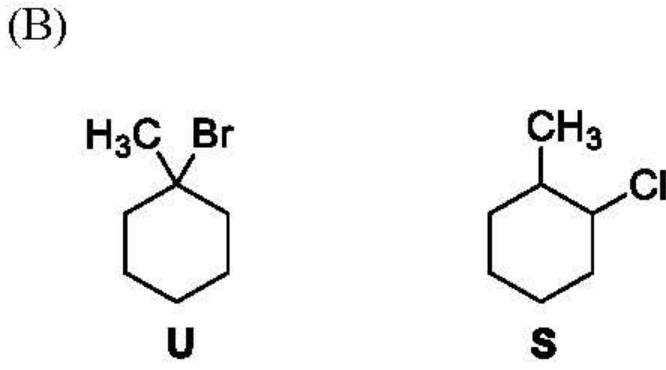
C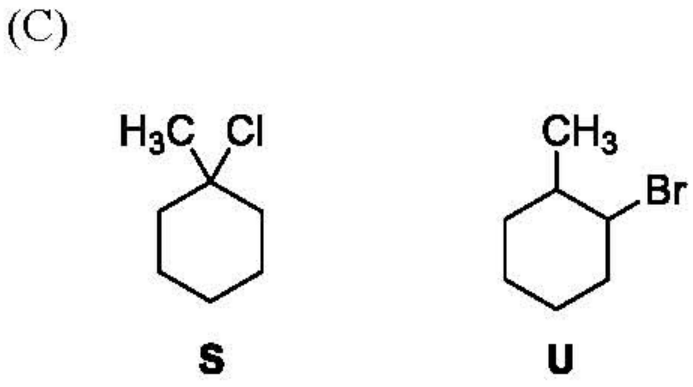 Correct
D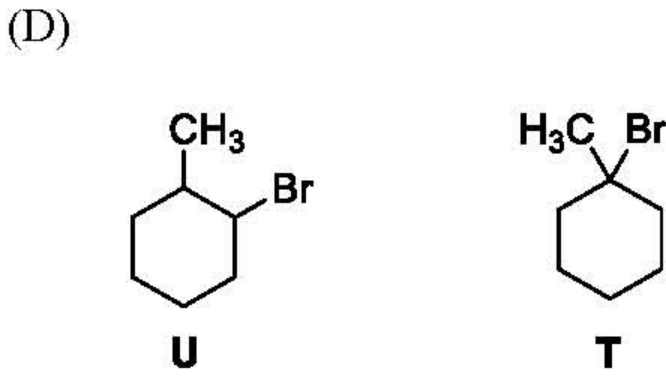 Correct
Step-by-Step Solution
To determine the correct option(s), we analyze each step in the reaction sequence:
1. Structure of Compound and Alkene :
- The starting compound reacts with Grignard reagent followed by hydrolysis () to form the alcohol , which is 1-methylcyclohexanol.
- Acid-catalyzed dehydration of using at yields the most substituted, most stable alkene as the major product , which is 1-methylcyclohexene.
2. Formation of Product :
- Reaction of (1-methylcyclohexanol) with concentrated proceeds via an pathway:
- Protonation of the group forms .
- Loss of a water molecule generates a highly stable tertiary () carbocation at position C-1 of the ring.
- Attack by nucleophilic gives 1-chloro-1-methylcyclohexane as the major product .
3. Formation of Product :
- Catalytic hydrogenation of (1-methylcyclohexene) with reduces the double bond to form methylcyclohexane.
- Free radical bromination of methylcyclohexane using occurs with high regioselectivity at the tertiary () carbon due to the superior stability of the free radical intermediate.
- Thus, the major product is 1-bromo-1-methylcyclohexane.
4. Formation of Product :
- Addition of to (1-methylcyclohexene) in the presence of benzoyl peroxide () and heat () proceeds via a radical mechanism (anti-Markovnikov addition or Kharasch effect):
- The bromine radical () adds to the less hindered C-2 carbon to generate the more stable tertiary () carbon radical at C-1.
- Hydrogen abstraction from yields 1-bromo-2-methylcyclohexane as the major product .
Conclusion and Option Verification:
- Option (C) correctly depicts as 1-chloro-1-methylcyclohexane and as 1-bromo-2-methylcyclohexane.
- Option (D) correctly depicts as 1-bromo-2-methylcyclohexane and as 1-bromo-1-methylcyclohexane.
Thus, the correct options are (C) and (D).