Hall Potential Difference Dependence on Metallic Strip Dimensions
In a thin rectangular metallic conductor strip, a steady current flows along the positive -axis, as shown in the illustration. The length, width, and thickness of this strip are denoted by , , and , respectively. A uniform external magnetic field acts along the positive -direction. Consequently, the mobile charge carriers experience a transverse magnetic deflection along the -direction. This causes accumulation of charge carriers on the planar surface and induces an equal and opposite charge layer on the surface opposite to . Therefore, a potential difference develops along the -direction. The accumulation of charges persists until the transverse magnetic force is counterbalanced by the electrostatic force. Assume that the electric current is distributed uniformly across the strip's cross-section and is conducted solely by electrons.
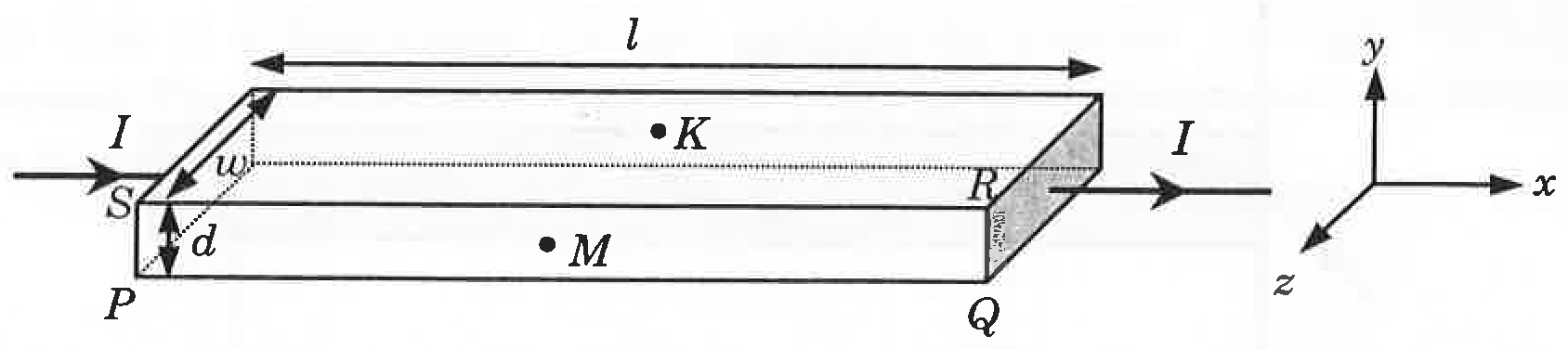
Consider two metallic strips (1 and 2) made of identical material. Their lengths are equal, with widths and , and thicknesses and , respectively. Two probe points and are located symmetrically on opposing faces parallel to the - plane (refer to the figure). Let and be the potential differences established between and in strips 1 and 2, respectively. For a fixed current flowing through each strip under a specified magnetic field strength , which of the following statement(s) is/are correct?
Options
If and , then
If and , then
If and , then
If and , then
Topics & Concepts
Step-by-Step Solution
To find the potential difference developed between points and , let us analyze the forces acting on the charge carriers (electrons) in the strip:
-
Current and Drift Velocity: The current flowing along the positive -axis through the strip of cross-sectional area is given by: where:
- is the charge carrier density (number of electrons per unit volume),
- is the elementary charge,
- is the drift velocity of the electrons along the negative -axis.
Solving for the drift velocity:
-
Equilibrium Condition (Hall Effect): The electrons experience a magnetic Lorentz force in the -direction due to the magnetic field :
This transverse deflection accumulates negative charges on one face and positive charges on the opposite face, setting up an opposing transverse electric field .
At equilibrium, the electric force balances the magnetic force:
-
Potential Difference: The probe points and lie on opposite faces parallel to the - plane, separated by distance along the -axis. Therefore, the Hall potential difference between and is:
Substituting the expression for :
From this result, we see that for strips of the same material (identical ) carrying the same current in the same magnetic field :
- is independent of the width .
- is inversely proportional to the thickness , i.e., .
Thus, the ratio of potential differences is:
Evaluating the given cases:
- For and :
- For and :
Correct Options: A, D