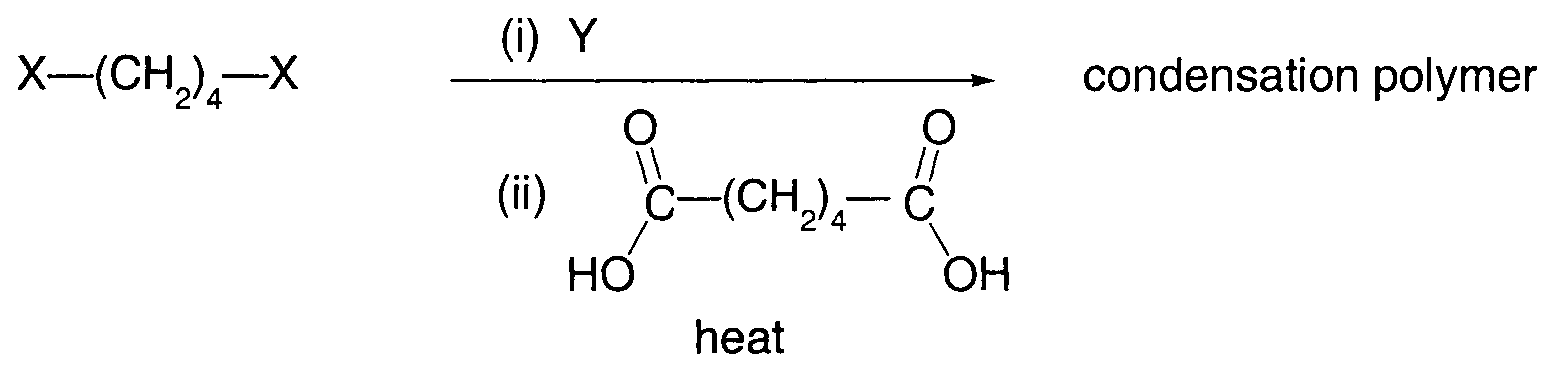
The reagent in the second step is adipic acid, HOOC−(CH2)4−COOH, a dicarboxylic acid containing 6 carbon atoms. For condensation polymerization with a dicarboxylic acid, the intermediate compound produced after treatment with Y should typically be a bifunctional monomer such as a diamine or a diol. Specifically, reaction of diamines with dicarboxylic acids forms polyamides (nylons).
Let us evaluate the options:
Analysis of Option (D):
Functional group: X=−CN
The starting compound is adiponitrile (hexanedinitrile): NC−(CH2)4−CN
Treatment with Y=H2/Ni/heat reduces the nitrile groups to primary amines: NC−(CH2)4−CNH2/Ni/ΔH2N−(CH2)6−NH2(hexamethylenediamine)
Subsequent reaction of hexamethylenediamine with adipic acid upon heating leads to the formation of the well-known condensation polymer Nylon-6,6: nH2N−(CH2)6−NH2+nHOOC−(CH2)4−COOHΔ[NH−(CH2)6−NH−CO−(CH2)4−CO]n+2nH2O
Thus, option (D) is correct.
Analysis of Option (C):
Functional group: X=−CONH2
The starting compound is adipamide: H2NOC−(CH2)4−CONH2
Treatment with Y=Br2/NaOH causes the Hofmann bromamide degradation reaction. In this reaction, primary amides are converted to primary amines with the loss of the carbonyl carbon: H2NOC−(CH2)4−CONH2Br2/NaOHH2N−(CH2)4−NH2(1,4-diaminobutane / tetramethylenediamine)
Reaction of 1,4-diaminobutane with adipic acid on heating undergoes condensation polymerization to form Nylon-4,6: nH2N−(CH2)4−NH2+nHOOC−(CH2)4−COOHΔ[NH−(CH2)4−NH−CO−(CH2)4−CO]n+2nH2O
Thus, option (C) is correct.
Analysis of Options (A) and (B):
In (A), catalytic hydrogenation using H2/Ni/heat does not effectively reduce esters (X=−COOCH3) to alcohols under standard laboratory conditions (esters generally require reagents such as LiAlH4 or CuO⋅CuCr2O4 under extreme conditions).
In (B), catalytic hydrogenation of primary amides using H2/Ni does not cleanly or primarily yield the corresponding amines.