Final Equilibrium Temperature of Gas System with Rigid Partition
The diagram illustrates an insulated container fitted with a frictionless, movable top piston. All outer walls and the piston consist of perfectly insulating material, preventing thermal exchange with the environment. The inner volume is split into two sections by a stationary, thermally conductive partition, facilitating gradual heat transfer between the chambers. The bottom chamber holds of a monatomic ideal gas initially at , while the upper chamber contains of a diatomic ideal gas at an initial temperature of . Molar heat capacities are given as for the monatomic gas, and for the diatomic gas.
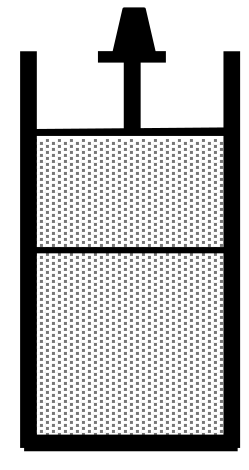
Assuming the dividing partition is fixed in place and immobile, determine the final equilibrium temperature of the gas system upon reaching thermal equilibrium.
Options
Topics & Concepts
Step-by-Step Solution
To find the final equilibrium temperature of the gas system, we analyze the thermodynamics of both compartments upon reaching thermal equilibrium at temperature .
1. Analysis of the Lower Compartment
- Gas type: Monatomic ideal gas
- Number of moles:
- Initial temperature:
- Molar heat capacity at constant volume:
Since the dividing partition is rigidly fixed, the volume of the lower compartment remains constant. The heat lost by the lower gas as its temperature decreases from to the final temperature is given by:
2. Analysis of the Upper Compartment
- Gas type: Diatomic ideal gas
- Number of moles:
- Initial temperature:
- Molar heat capacity at constant pressure:
The top piston is frictionless and free to move, which keeps the pressure in the upper compartment constant throughout the process. The heat gained by the upper gas as its temperature increases from to at constant pressure is given by:
3. Energy Conservation
Since the outer container and the piston are perfectly insulated, no heat is exchanged with the surroundings:
Substituting the expressions for and :
Substitute the given values:
Simplify the equation:
Divide both sides by :
Rearrange terms to solve for :
Thus, the final equilibrium temperature of the gas system is .
Correct Answer: D