Capillary Rise of Water in Truncated Conical Glass Tube
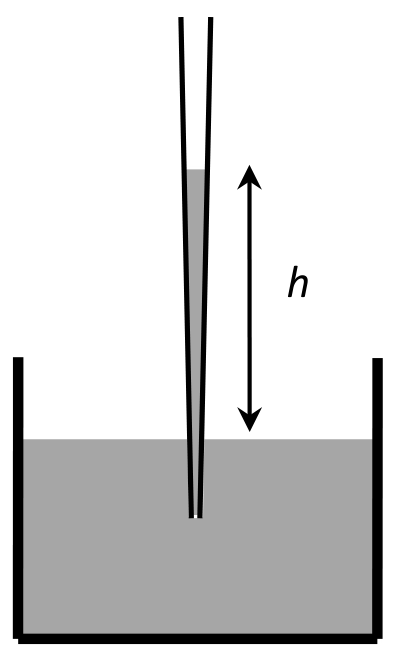
A glass capillary tube has the geometry of a truncated cone with an apex angle , such that its ends possess different cross-sectional radii. When immersed vertically into water, the liquid ascends to an equilibrium height , at which the internal radius of the cross section is . If the surface tension of water is , its mass density is , and the contact angle with glass is , the value of is given by ( denotes the acceleration due to gravity):
Options
Topics & Concepts
Step-by-Step Solution
To determine the height to which water ascends in the conical capillary tube, we can analyze the equilibrium of the liquid column by considering the forces acting on it at the upper contact line.
1. Geometry of the Conical Tube
- The apex angle of the truncated cone is .
- The semi-vertical angle (the angle made by the inner wall of the tube with the vertical axis) is:
- Since the tube tapers upwards, the inner glass wall is inclined inwards at an angle relative to the vertical.
2. Direction of Surface Tension Force
- The surface tension force acts along the liquid-gas interface at the line of contact (a circle of radius ).
- The contact angle is the angle between the glass surface (wall of the tube) and the liquid-gas interface.
- Since the wall itself is inclined at an angle to the vertical, the angle made by the surface tension force vector with the vertical direction is:
3. Vertical Force Balance
At equilibrium, the upward component of the surface tension force balances the weight of the elevated liquid column.
-
Upward force due to surface tension (): The perimeter of the cross-section at height is . The upward vertical component of the surface tension force is:
-
Downward force due to gravity (): Neglecting the small volume of the meniscus, the weight of the liquid column of radius and height is:
Equating the upward surface tension force to the weight of the liquid column:
4. Solving for Height
Canceling common terms on both sides:
Thus, the correct option is D.