Estimation of Diffusion Distance Using Grahams Law
and are two volatile liquids with molar masses of and respectively. Two cotton plugs, one soaked in and the other soaked in , are introduced simultaneously at the ends of a tube of length , as shown in the diagram. The tube is filled with an inert gas at pressure and a temperature of . Vapours of and diffuse and react to form a product which is first detected at a distance from the plug soaked in . Consider and to possess identical molecular diameters and assume ideal behavior for the inert gas as well as the two vapours.
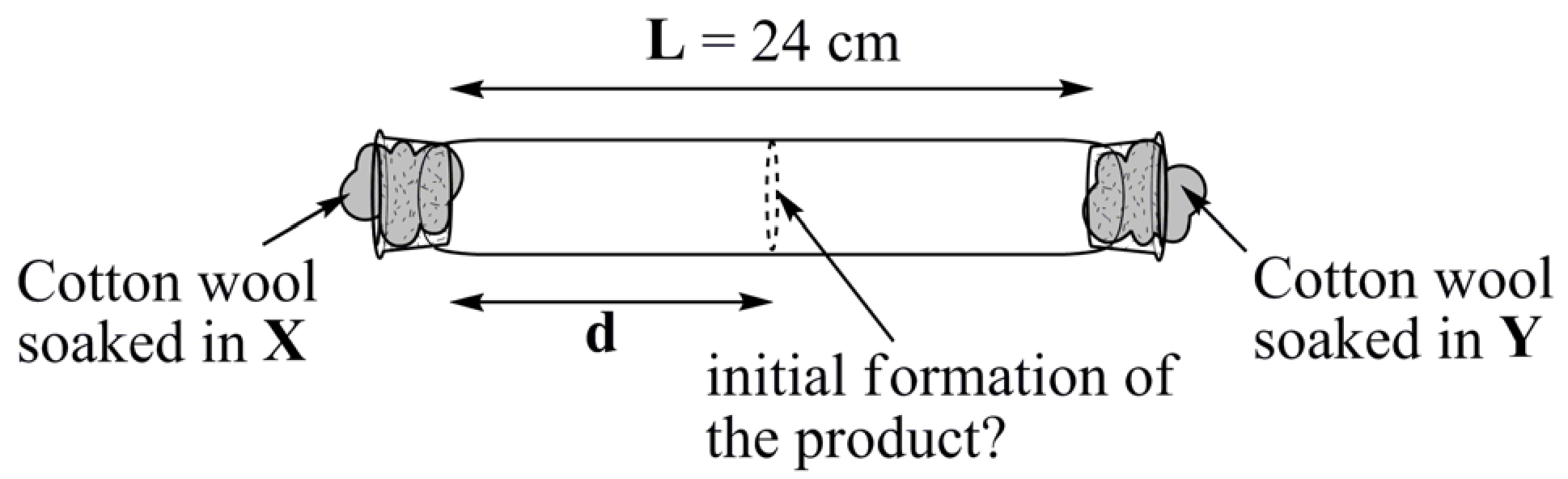
The value of distance in (as illustrated in the figure), estimated via Graham's law, is
Options
Topics & Concepts
Step-by-Step Solution
According to Graham's law of diffusion, the rate of diffusion of a gas is inversely proportional to the square root of its molar mass under identical conditions of temperature and pressure:
Since the vapours of and start diffusing simultaneously from opposite ends of the tube of length , the time taken by both gases to meet and form the product is the same.
Let:
- be the distance travelled by the vapour of .
- be the distance travelled by the vapour of .
The ratio of their rates of diffusion is given by:
Applying Graham's law:
Given:
Substitute the given values into the equation:
Solving for :
Thus, the estimated value of distance via Graham's law is , which corresponds to Option (C).