Equilibrium of Block on Inclined Plane under Horizontal Force
Consider a small block having a mass of positioned on a stationary inclined plane making an angle with the horizontal surface. A horizontal force with magnitude acts on the block through its center of mass as depicted. Assuming , the block stays in static equilibrium if:
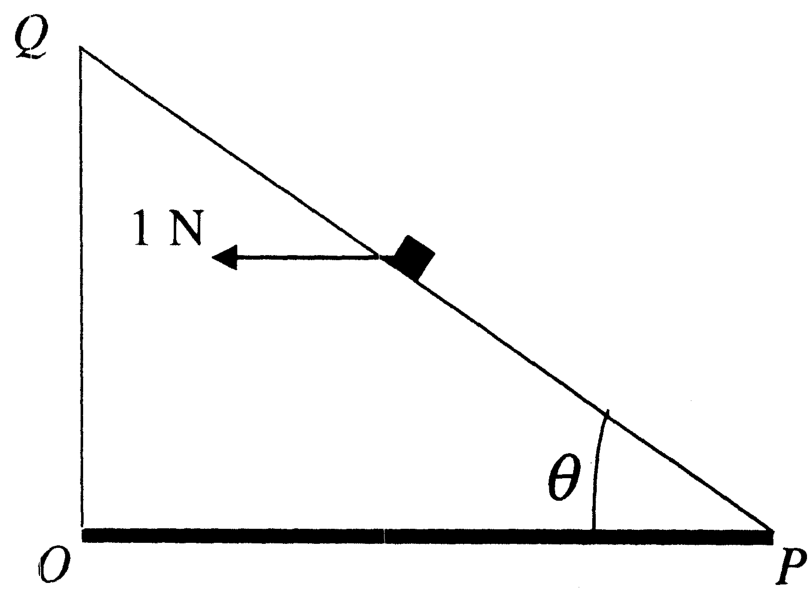
Options
and the force of friction acts on the block directed towards .
and the force of friction acts on the block directed towards .
and the force of friction acts on the block directed towards .
Topics & Concepts
Step-by-Step Solution
To determine the condition for static equilibrium of the block on the inclined plane , let us analyze all the forces acting on the block of mass .
1. Forces Acting on the Block
- Weight (): Acts vertically downwards through the center of mass.
- Applied Horizontal Force (): Acts horizontally to the left.
- Normal Force (): Perpendicular to the inclined plane .
- Frictional Force (): Acts parallel to the inclined plane .
2. Force Components Parallel to the Incline
-
Component of weight down the incline (directed towards ):
-
Component of horizontal force up the incline (directed towards ):
The net tendency of motion parallel to the incline is determined by comparing and :
3. Analysis of Options
-
Case 1: When Since the parallel components balance each other, no frictional force is required (). The block naturally stays in static equilibrium. (Option A is correct)
-
Case 2: When For , we have . The downward force component towards is greater than the upward force component towards . Hence, the block tends to slide down towards .
To prevent sliding and maintain static equilibrium, the static friction force must oppose this tendency and act up the incline, directed towards . (Option C is correct)
-
Case 3: When For , we have . The upward force component towards is greater, so the block tends to slide up towards . Friction must act down the incline, directed towards . (Options B and D are incorrect)
Conclusion
The correct statements are A and C.