Electrophilic Substitution Pattern of Substituted Phenol
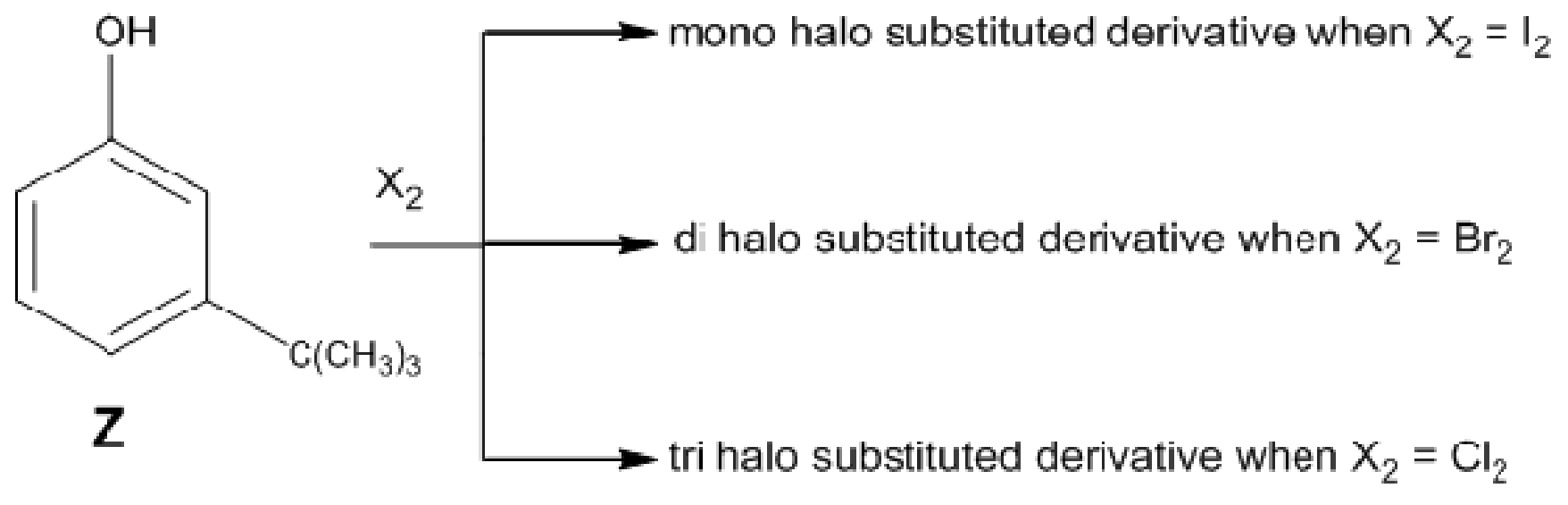
The halogenation reactivity of compound Z under suitable conditions is outlined below:
The observed trend in electrophilic substitution can be attributed to:
Options
the steric effect exerted by the halogen
the steric effect exerted by the tert-butyl group
the electronic influence of the phenolic OH group
the electronic influence of the tert-butyl group
Step-by-Step Solution
To determine the factors influencing the halogenation reactivity of compound Z (), let us analyze the structural and electronic characteristics of the molecule and the electrophiles:
-
Structure of Compound Z: Compound Z is , where the hydroxyl group () is at position 1 and the bulky group () is at position 3.
-
Electronic Influence of the Phenolic Group (Option C):
- The group is a strong activating group due to its positive mesomeric () resonance effect.
- It directs electrophilic aromatic substitution to the positions and relative to itself, which correspond to positions 2, 4, and 6 on the benzene ring.
- Thus, the position of electrophilic attack is primarily governed by the electronic influence of the phenolic group.
-
Steric Effect of the Group (Option B):
- The group () is extremely bulky.
- Position 2 lies directly between the group and the group, making it severely sterically hindered.
- Position 4 is also adjacent to the group and experiences significant steric crowding compared to position 6.
- Thus, the steric bulk of the group restricts access to certain positions depending on the size of the incoming halogen electrophile.
-
Steric Effect of the Halogen (Option A):
- The atomic/ionic radii of the halogens increase down the group:
- Chlorine (): Chlorine is small enough to overcome the steric hindrance at all activated positions (2, 4, and 6), yielding a tri-halo substituted derivative.
- Bromine (): Bromine is larger, so it cannot readily attack the most hindered position 2 between and the group. Thus, substitution occurs at positions 4 and 6, giving a di-halo substituted derivative.
- Iodine (): Iodine is the largest among the three. Due to severe steric repulsion with the group, substitution is restricted to the least hindered position (position 4/6), yielding a mono-halo substituted derivative.
- Hence, the steric size of the halogen directly dictates the extent of substitution (mono, di, or tri).
-
Electronic Influence of the Group (Option D):
- The group exhibits a weak (inductive) effect and lacks required for hyperconjugation. Its electronic contribution is negligible compared to the effect of the group and does not explain the differential substitution pattern across the halogens.
Therefore, the observed pattern of electrophilic substitution is governed by:
- (A) the steric effect exerted by the halogen
- (B) the steric effect exerted by the tert-butyl group
- (C) the electronic influence of the phenolic OH group
Correct Options: A, B, C