JEE Challenger
More from Electric Charges and Fields

Electric Flux Through Shaded Area in Uniform Field

Consider an electric field E⃗=E0x^\vec{E} = E_0 \hat{x}, where E0E_0 is a constant. The flux through the shaded area (as shown in the figure) due to this field is
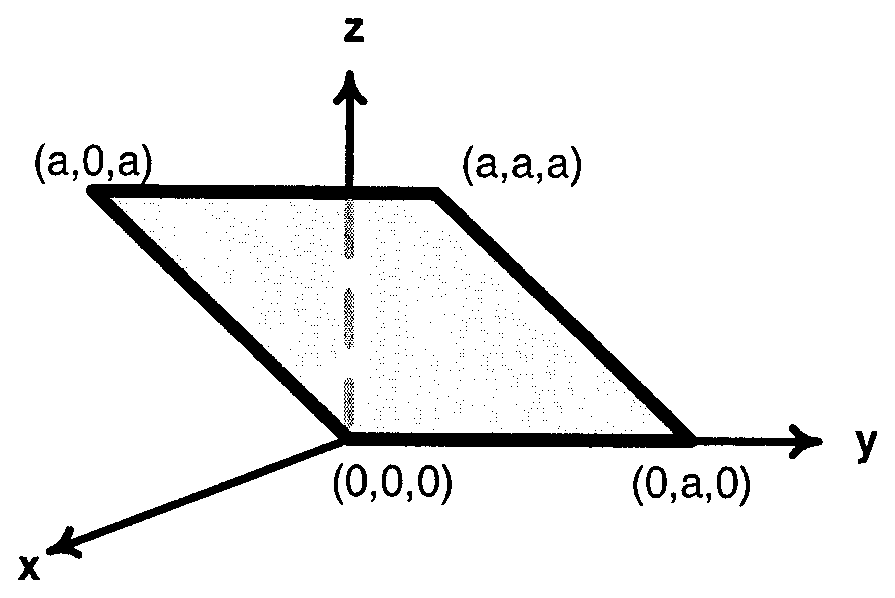
Diagram 0

Options

A

2E0a22E_0 a^2

B

2E0a2\sqrt{2}E_0 a^2

C

E0a2E_0 a^2

Correct
D

E0a22\frac{E_0 a^2}{\sqrt{2}}

Step-by-Step Solution

To find the electric flux through the given shaded surface, we can use two simple and equivalent approaches: using the vector area method or the projected area method.

Method 1: Using Area Vector

The vertices of the shaded surface, as given in the figure, are:

  • A=(0,0,0)A = (0, 0, 0)
  • B=(0,a,0)B = (0, a, 0)
  • C=(a,a,a)C = (a, a, a)
  • D=(a,0,a)D = (a, 0, a)

We can define two adjacent side vectors of the parallelogram ABCDABCD:
AB⃗=(0−0)i^+(a−0)j^+(0−0)k^=aj^\vec{AB} = (0 - 0)\hat{i} + (a - 0)\hat{j} + (0 - 0)\hat{k} = a\hat{j}
AD⃗=(a−0)i^+(0−0)j^+(a−0)k^=ai^+ak^\vec{AD} = (a - 0)\hat{i} + (0 - 0)\hat{j} + (a - 0)\hat{k} = a\hat{i} + a\hat{k}

The vector area S⃗\vec{S} of the planar surface is the cross product of these two side vectors:
S⃗=AD⃗×AB⃗=(ai^+ak^)×(aj^)\vec{S} = \vec{AD} \times \vec{AB} = (a\hat{i} + a\hat{k}) \times (a\hat{j})
S⃗=a2(i^×j^)+a2(k^×j^)=a2k^−a2(−i^)=a2i^+a2k^\vec{S} = a^2(\hat{i} \times \hat{j}) + a^2(\hat{k} \times \hat{j}) = a^2\hat{k} - a^2(-\hat{i}) = a^2\hat{i} + a^2\hat{k}

The given uniform electric field is:
E⃗=E0i^\vec{E} = E_0 \hat{i}

The electric flux Φ\Phi through the surface is given by the dot product of the electric field and the area vector:
Φ=E⃗⋅S⃗=(E0i^)⋅(a2i^+a2k^)\Phi = \vec{E} \cdot \vec{S} = (E_0 \hat{i}) \cdot (a^2 \hat{i} + a^2 \hat{k})
Φ=E0a2(i^⋅i^)+E0a2(i^⋅k^)\Phi = E_0 a^2 (\hat{i} \cdot \hat{i}) + E_0 a^2 (\hat{i} \cdot \hat{k})
Φ=E0a2(1)+0=E0a2\Phi = E_0 a^2 (1) + 0 = E_0 a^2


Method 2: Projected Area Method

Since the electric field E⃗=E0i^\vec{E} = E_0 \hat{i} is directed entirely along the xx-axis, the flux through the surface is equal to the magnitude of the field multiplied by the area of the surface projected onto a plane perpendicular to the xx-axis (the yzyz-plane).

  1. Projecting the vertices onto the yzyz-plane gives:

    • A′=(0,0,0)A' = (0, 0, 0)
    • B′=(0,a,0)B' = (0, a, 0)
    • C′=(0,a,a)C' = (0, a, a)
    • D′=(0,0,a)D' = (0, 0, a)
  2. The projection forms a square in the yzyz-plane of side length aa.

  3. The area of this projected region is:
    Aproj=a×a=a2A_{\text{proj}} = a \times a = a^2

  4. The flux through the shaded surface is therefore:
    Φ=E0⋅Aproj=E0a2\Phi = E_0 \cdot A_{\text{proj}} = E_0 a^2

Thus, the correct option is (C).