Electric Field Inside Off Center Spherical Cavity
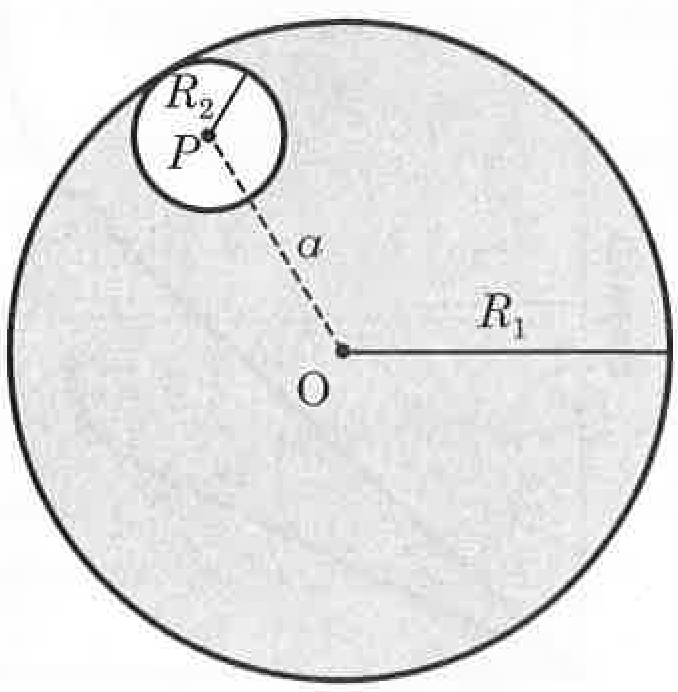
A uniform spherical charge distribution has radius and is centered at origin . A spherical cavity having radius centered at point with separation is created within it (refer to the figure). If represents the electric field inside this cavity at position , select the correct option(s):
Options
is uniform, its magnitude is independent of but its direction depends on
is uniform, its magnitude depends on and its direction depends on
is uniform, its magnitude is independent of but its direction depends on
is uniform and both its magnitude and direction depend on
Topics & Concepts
Step-by-Step Solution
To find the electric field inside the off-center spherical cavity, we can use the principle of superposition.
Let the uniform volume charge density of the solid sphere be .
-
Field due to a solid sphere centered at origin : Consider a solid sphere of radius with uniform charge density , centered at the origin . Using Gauss's Law, the electric field at any point with position vector relative to inside the sphere is given by:
-
Field due to the spherical cavity: Creating a cavity centered at point (with position vector ) is equivalent to superimposing a smaller sphere of radius with a charge density of centered at .
The position vector of the point inside the cavity relative to is .
The electric field produced by this sphere of negative charge density at the same point is:
-
Net Electric Field inside the cavity: By the principle of superposition, the net electric field at any point inside the cavity is:
-
Conclusion:
- The expression is independent of the position vector , meaning that the electric field inside the cavity is uniform throughout its volume.
- The magnitude of the electric field is , which depends on the magnitude of the displacement vector .
- The direction of the electric field is parallel to the vector .
Thus, the electric field is uniform and both its magnitude and direction depend on .
Correct Option: D