Analysis of Stress versus Strain Curve with Swapped Axes
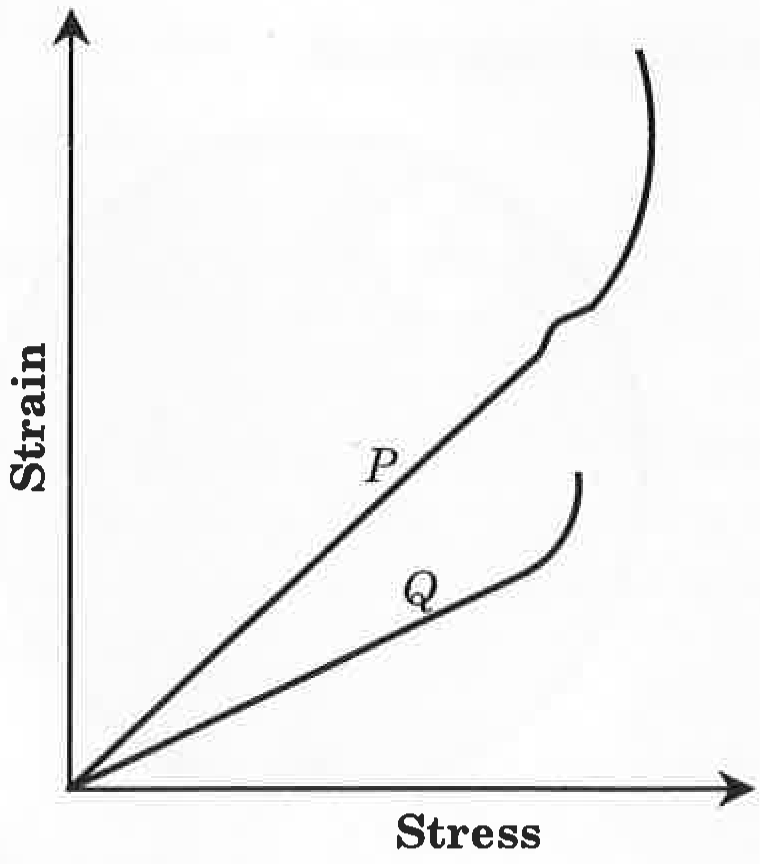
While plotting stress versus strain curves for two materials and , a student erroneously places strain along the -axis and stress along the -axis as depicted in the graph. Identify the valid statement(s):
Options
has more tensile strength than
is more ductile than
is more brittle than
The Young's modulus of is more than that of
Topics & Concepts
Step-by-Step Solution
To determine the correct statements, let us analyze the given graph step-by-step:
1. Young's Modulus ()
Young's modulus is defined as the ratio of tensile stress () to tensile strain ():
In the given graph, strain is plotted along the -axis () and stress is plotted along the -axis (). Therefore, the slope of the linear proportional region is given by:
From the graph:
- The line for is steeper than that for in the linear region, meaning .
- Since Young's modulus is inversely proportional to the slope of this graph, we have: Thus, the Young's modulus of is less than that of . Option (D) is incorrect.
2. Tensile Strength
Tensile strength refers to the maximum stress a material can withstand before fracture (ultimate tensile stress).
- Since stress is represented along the horizontal -axis, the ultimate tensile strength corresponds to the maximum -coordinate reached by the curve.
- From the graph, curve extends further to the right along the -axis than curve , which means:
Thus, material has a higher tensile strength than material . Option (A) is correct.
3. Ductility and Brittleness
Ductility is measured by the amount of plastic strain (permanent deformation) a material undergoes before breaking. Brittleness implies that a material breaks with very little plastic deformation beyond its elastic limit.
- Strain is represented along the vertical -axis.
- Curve extends significantly higher along the -axis into the plastic region, indicating a much higher strain at fracture compared to curve .
- Since undergoes much larger plastic deformation before fracture, material is more ductile and less brittle than material .
Thus, Option (B) is correct and Option (C) is incorrect.
Final Conclusion
The valid statements are (A) and (B).