Electric Field in Overlapping Region of Two Charged Spheres
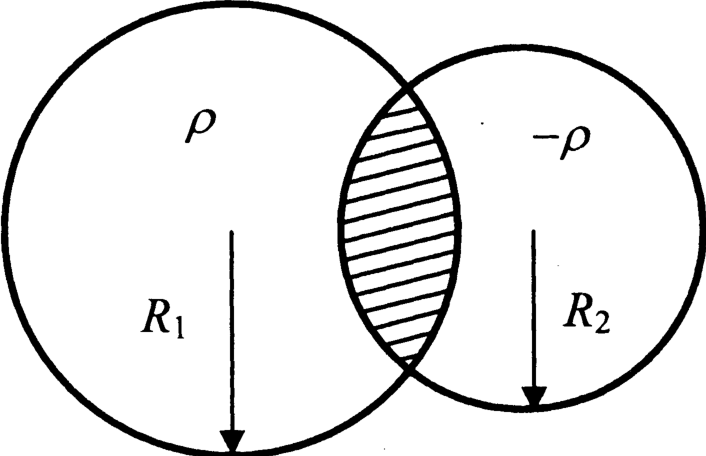
Consider two non-conducting spheres having radii and with uniform volume charge densities and respectively. They are arranged such that they partially overlap, as illustrated in the figure. Throughout the overlapping zone,
Options
the electrostatic field is zero.
the electrostatic potential remains constant.
the electrostatic field is constant in magnitude.
the electrostatic field maintains a uniform direction.
Topics & Concepts
Step-by-Step Solution
To determine the nature of the electric field and electrostatic potential in the overlapping region of the two non-conducting spheres, we use the principle of superposition.
Let:
- be the center of the sphere of radius with a uniform volume charge density of .
- be the center of the sphere of radius with a uniform volume charge density of .
- be the position vector of center relative to center ().
Consider a point located inside the overlapping region. Let and be the position vectors of point relative to and , respectively. From vector addition, we have:
Using Gauss's Law, the electric field at an internal point of a uniformly charged sphere of charge density at a distance from its center is:
Similarly, the electric field due to the sphere of charge density at a distance from its center is:
By the principle of superposition, the net electric field at point is:
Substituting into the expression yields:
Conclusion:
- Magnitude: The magnitude of the electric field is , which is constant for all points in the overlapping region.
- Direction: The direction of the electric field is directed along the constant displacement vector (from to ), which is uniform throughout the overlapping region.
- Potential: Since and is uniform, the electrostatic potential changes linearly along the direction of according to , so the potential is not constant.
Thus, options C and D are correct.