Electric Field and Potential Variation for Uniformly Charged Thin Spherical Shell
Consider a thin spherical shell of radius centered at the origin with a uniform positive surface charge density. Which graph accurately depicts the variation of the electric field magnitude and electric potential as functions of distance from the center?
Options
A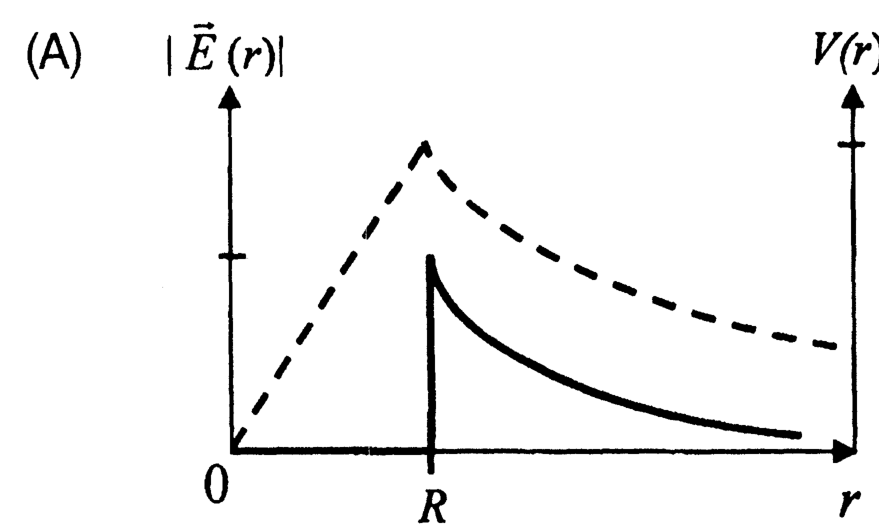
B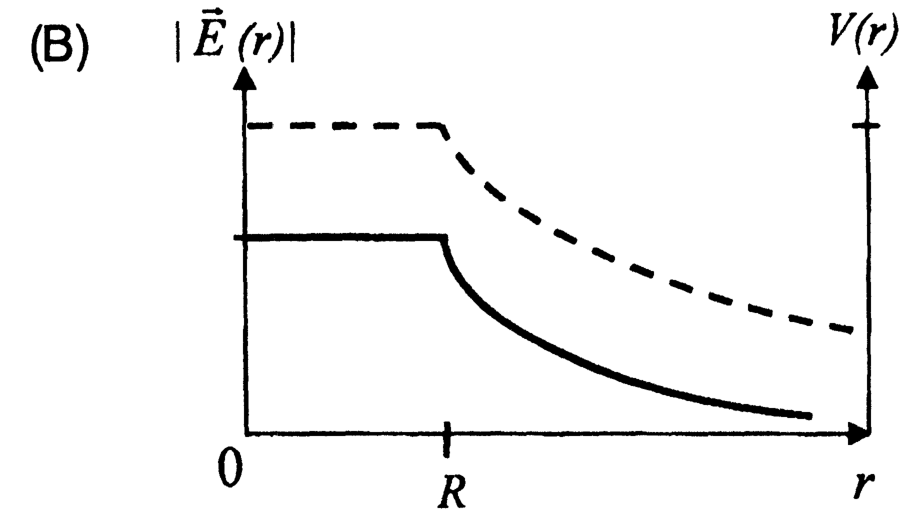
C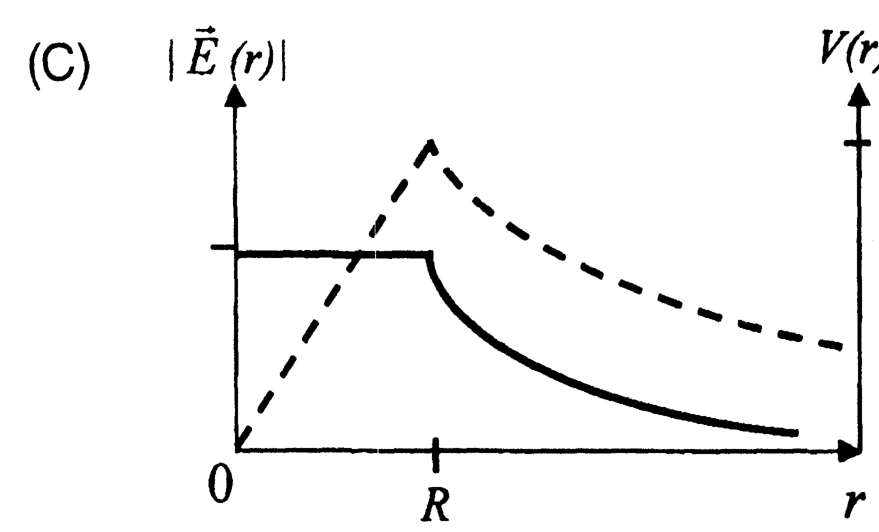
D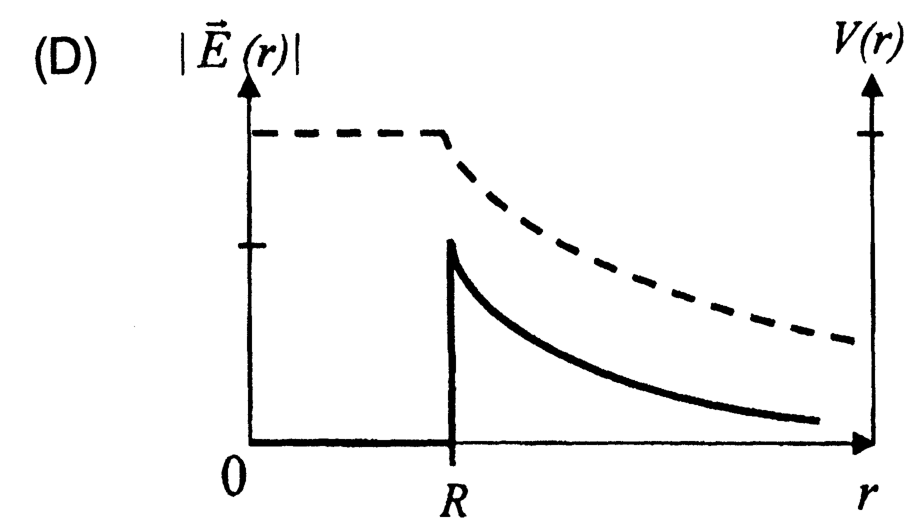 Correct
Topics & Concepts
Step-by-Step Solution
To find the variation of the magnitude of the electric field and the electric potential with distance from the center of a thin spherical shell of radius carrying a uniform positive charge :
-
Electric Field : Applying Gauss's Law, taking a concentric spherical Gaussian surface of radius :
- For points inside the shell (): The enclosed charge is . Therefore, by Gauss's Law:
- For points outside the shell (): The entire charge is enclosed:
- Thus, is zero for , has a jump discontinuity at the surface , and falls off as for . This is represented by the solid curve.
-
Electric Potential : The electric potential is related to the electric field by , with :
- For points outside the shell ():
- For points inside the shell (): Since inside, the potential remains constant and equal to its value at the surface:
- Thus, is constant for and decreases continuously as for . This is represented by the dashed curve.
Graph (D) correctly depicts:
- The solid curve being zero for and decaying as for , representing .
- The dashed curve being constant for and decaying as for , representing .
Hence, the correct option is D.