Electric Dipole Fixed at Origin in Uniform Electric Field
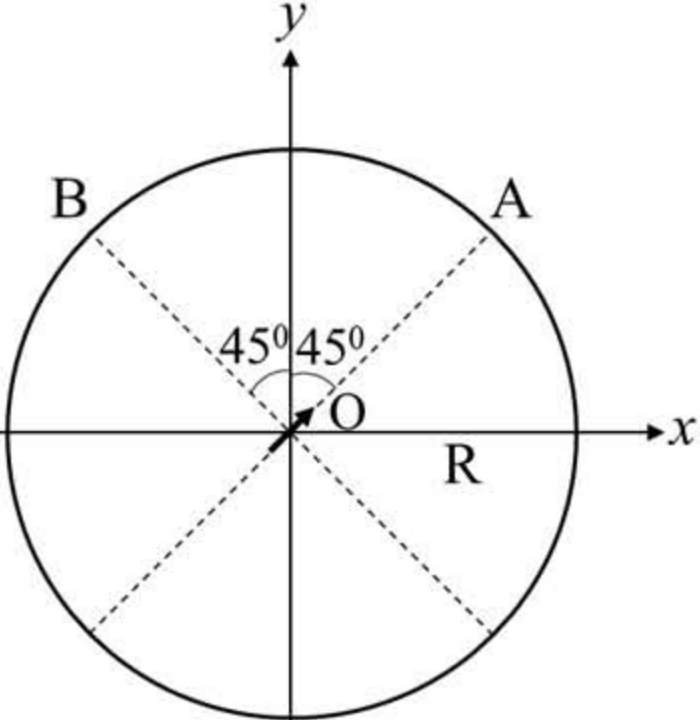
An electric dipole having dipole moment 2p0(i^+j^) is positioned at the origin O fixed in space. It is placed within a uniform electric field of magnitude E0. Provided that the electric potential remains constant along a circular path of radius R centered at the origin as depicted in the figure, identify the valid statement(s): (Assume ϵ0 is the permittivity of free space, and R≫ dipole size)
Options
A
R=(4πϵ0E0p0)1/3
Correct
B
Total electric field at point A is EA=2E0(i^+j^)
C
Total electric field at point B is EB=0
Correct
D
The magnitude of the net electric field at any two locations on the circle is identical.
To solve this problem, we analyze the electric potential and electric field created by both the fixed electric dipole and the uniform external electric field.
1. Expression for Electric Potential
The dipole moment is given by:
p=2p0(i^+j^)=p0n^p
where n^p=2i^+j^ is a unit vector along the 45∘ line relative to the positive x-axis.
The electric potential at a point with position vector r=Rr^ on the circle of radius R due to the dipole is:
Vdipole(r)=4πϵ01R2p⋅r^=4πϵ0R2p0(n^p⋅r^)
Let the uniform electric field be E0. The potential associated with this uniform electric field is:
Vext(r)=−E0⋅r=−R(E0⋅r^)
The total electric potential on the circle of radius R is:
V(r)=Vdipole(r)+Vext(r)=(4πϵ0R2p0n^p−RE0)⋅r^
Given that the potential remains constant along the circular path of radius R, the potential must be independent of r^. This requires the vector coefficient of r^ to vanish:
4πϵ0R2p0n^p−RE0=0
From this, we find:
E0=4πϵ0R3p0n^p
Taking the magnitude on both sides (since ∣n^p∣=1 and ∣E0∣=E0):
E0=4πϵ0R3p0⟹R=(4πϵ0E0p0)1/3
Thus, Statement (A) is correct.
2. Total Electric Field on the Circle
The uniform electric field is:
E0=E0n^p=2E0(i^+j^)
The electric field of the dipole at any point r=Rr^ on the circle is given by:
Edipole(r)=4πϵ0R31[3(p⋅r^)r^−p]=E0[3(n^p⋅r^)r^−n^p]
The total electric field at position r is:
Etotal(r)=Edipole(r)+E0=E0[3(n^p⋅r^)r^−n^p]+E0n^p=3E0(n^p⋅r^)r^
3. Analysis of Options B, C, and D
At Point A:
Point A is located along the direction of p at θ=45∘, so r^A=n^p=2i^+j^.
EA=3E0(n^p⋅n^p)n^p=3E0n^p=23E0(i^+j^)
Thus, Statement (B) is incorrect.
At Point B:
Point B is located at θ=135∘, so r^B=2−i^+j^.
Since r^B⊥n^p, we have n^p⋅r^B=0:
EB=3E0(0)r^B=0
Thus, Statement (C) is correct.
Magnitude of Net Electric Field:
The magnitude of the total electric field at any point on the circle is:
∣Etotal(r)∣=3E0∣n^p⋅r^∣=3E0∣cos(θ−45∘)∣
Since this magnitude depends explicitly on the angle θ, it varies along the circle (e.g., 3E0 at point A and 0 at point B).
Thus, Statement (D) is incorrect.