Distance of Mass Moving in Radial Slot of Rotating Disc
A frame of reference that accelerates relative to an inertial reference frame is defined as a non-inertial frame. For example, a coordinate frame attached to a circular disc rotating about a fixed vertical axis with constant angular velocity serves as a non-inertial frame.\n\nThe force observed in the rotating frame and the force in an inertial frame on a particle of mass are connected by:\n\nwhere represents the velocity of the particle within the rotating frame, and is its position vector measured from the centre of the disc.\n\nConsider a smooth slot along a diameter of a disc of radius that rotates counter-clockwise with a constant angular speed around its central vertical axis. We set up a coordinate system with its origin at the disc's center, where the -axis lies along the slot, the -axis is perpendicular to it, and the -axis coincides with the rotation axis (so ). A small object of mass is gently placed inside the slot at position at time and is restricted to move purely along the slot.
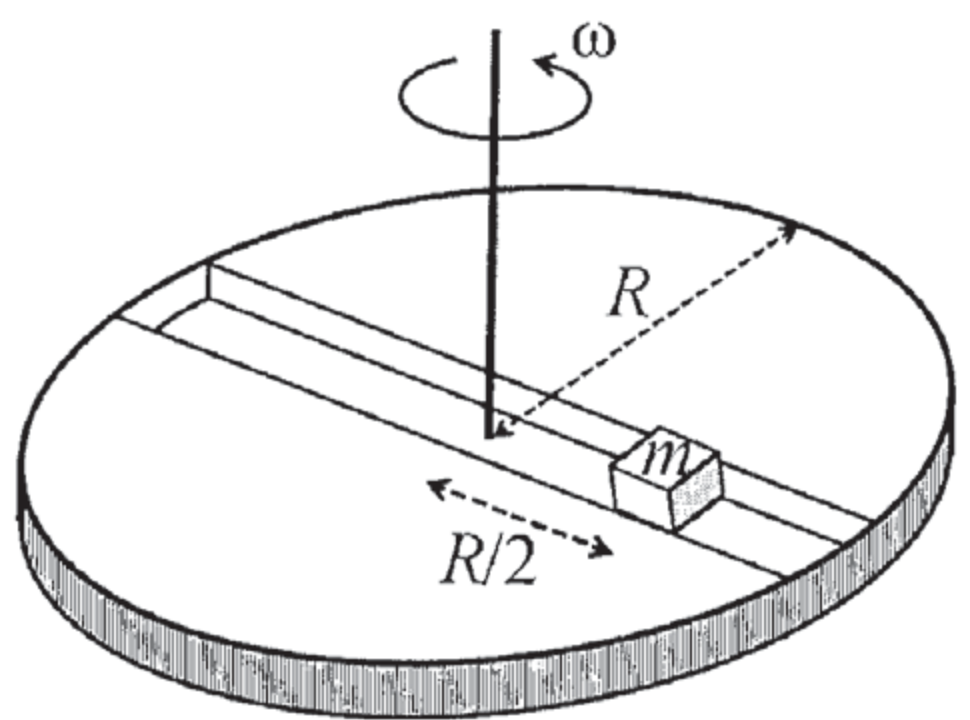
Determine the distance of the block from the center at time .
Options
Topics & Concepts
Step-by-Step Solution
To find the distance of the block from the center of the disc at any time , we analyze the motion of the block in the non-inertial rotating frame attached to the disc.
1. Motion in the Rotating Frame
The position of the block along the radial slot (-axis) is given by:
The velocity of the block relative to the rotating frame is:
The angular velocity vector of the disc is:
The equation for the force acting on the particle in the rotating frame is:
2. Analysis of the Component Forces
-
Real Forces (): Since the slot is smooth, there is no frictional force along the slot (-axis). The normal reaction forces act along the -axis (from the side walls of the slot) and the -axis (balancing gravity). Thus, the real force along the -axis is zero:
-
Coriolis Force: This force acts entirely along the -axis and does not affect the radial motion along the -axis.
-
Centrifugal Force: This force acts outwards along the -axis.
3. Differential Equation of Motion
Applying Newton's second law along the -axis in the rotating frame:
Dividing by :
The general solution to this homogeneous second-order linear differential equation is:
4. Applying Initial Conditions
-
At , the block is placed at a distance :
-
At , the block is gently released, meaning its relative velocity is zero, i.e., :
Substituting into the first equation:
5. Final Expression for Distance
Substituting the constants and back into :
Thus, the correct option is A.