Dimensionless Heat Supplied to Gas Chamber
A thermally insulated cylinder is divided into two parts by a frictionless and thermally insulating movable partition. Each section initially contains one mole of an ideal gas with constant volume molar heat capacity . Here, represents the gas constant. Initially, both sides have volume and temperature . An electric heater on the left side is activated at very low power, supplying heat to the left gas. Consequently, the partition moves slowly to the right, reducing the volume of the right chamber to . The final temperatures of the gases on the left and right sides are and , respectively. Temperature changes of the cylinder, partition, and heater may be neglected.
Determine the dimensionless value of .
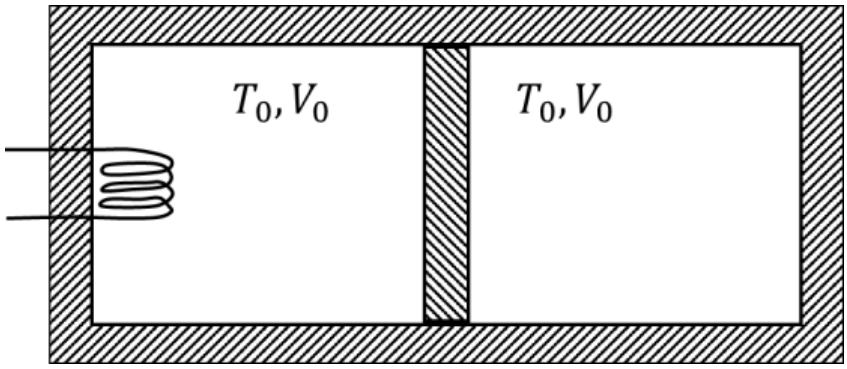
Options
Topics & Concepts
Step-by-Step Solution
To determine the dimensionless value of , we apply the principles of thermodynamics to both the left and right gas chambers.
1. Initial Parameters
Each chamber contains of ideal gas with constant volume molar heat capacity:
The adiabatic exponent for this gas is:
Initially, both chambers have:
- Volume:
- Temperature:
- Pressure:
2. Process for the Right Chamber
Since the cylinder walls and the partition are thermally insulating and the process occurs very slowly (quasistatically), the gas in the right chamber undergoes a reversible adiabatic compression.
The final volume of the right chamber is .
Using the adiabatic relation :
Using the adiabatic relation to find the final equilibrium pressure :
3. Process for the Left Chamber
Since the total volume of the insulated cylinder remains , the final volume of the left chamber is:
Since the partition is frictionless, the final pressure on the left side must equal the final pressure on the right side:
Applying the ideal gas equation for the left chamber in its final state:
4. Heat Supplied () via First Law of Thermodynamics
Considering both gas chambers together as a single composite system:
- The external work done by the system is zero () because the outer boundaries are rigid.
- Heat is supplied only to the left chamber from the electric heater.
By the First Law of Thermodynamics:
Calculating the change in internal energy for each side:
Summing these changes:
Rearranging to get the dimensionless ratio:
Correct Answer:
B