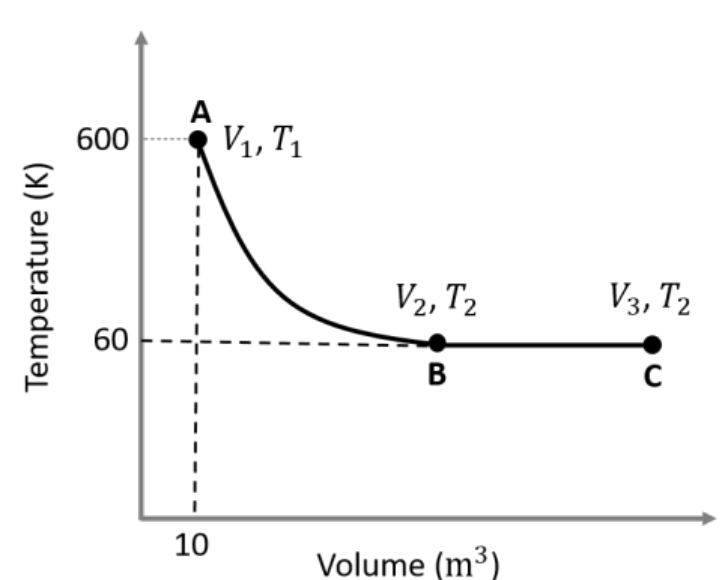
For one mole (n=1) of an ideal monoatomic gas, the heat capacity at constant volume is:
Cv,m=Cp,m−R=25R−R=23R
The adiabatic index (Poisson's ratio) γ is given by:
γ=Cv,mCp,m=23R25R=35
Thus, γ−1=35−1=32.
Step 1: Process A→B (Reversible Adiabatic Expansion)
From the graph:
- Temperature at A, T1=600 K
- Volume at A, V1=10 m3
- Temperature at B, T2=60 K
Since A→B is a reversible adiabatic process:
qA→B=0
Using the relation TVγ−1=constant:
T1V1γ−1=T2V2γ−1
Substitute the known values:
600×102/3=60×V22/3
60600=(10V2)2/3
10=(10V2)2/3
V2=10×103/2=105/2 m3
Step 2: Process B→C (Reversible Isothermal Expansion)
Since the temperature remains constant at T2=60 K during B→C, the heat absorbed in this reversible isothermal process is:
qB→C=nRT2ln(V2V3)=RT2ln(V2V3)
The total heat absorbed in the entire process A→B→C is:
qtotal=qA→B+qB→C=0+RT2ln(V2V3)
Given that qtotal=RT2ln10:
RT2ln(V2V3)=RT2ln10
ln(V2V3)=ln10⟹V3=10V2
Substitute V2=105/2 m3:
V3=10×105/2=107/2 m3
Step 3: Calculation of 2logV3
Taking the base-10 logarithm of V3:
log10V3=log10(107/2)=27
Therefore:
2logV3=2×27=7