JEE Challenger
More from Equilibrium

Calculate Standard Gibbs Energy Difference Constant from Equilibrium Progress

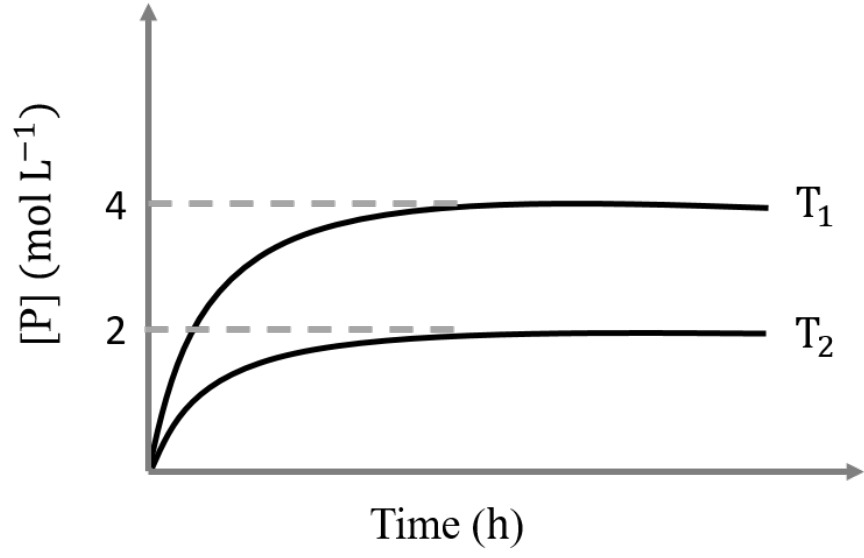
In a one-litre flask, 6 moles6\text{ moles} of A\text{A} undergoes the reaction A (g)P (g)\text{A (g)} \rightleftharpoons \text{P (g)}. The progress of product formation at two temperatures (in Kelvin), T1\text{T}_1 and T2\text{T}_2, is shown in the figure:

If T1=2T2\text{T}_1 = 2\text{T}_2 and (ΔG2ΔG1)=RT2lnx(\Delta G_2^\ominus - \Delta G_1^\ominus) = \text{RT}_2 \ln x, then the value of xx is _____.

[ΔG1\Delta G_1^\ominus and ΔG2\Delta G_2^\ominus are standard Gibb's free energy change for the reaction at temperatures T1\text{T}_1 and T2\text{T}_2, respectively.]

Question Diagram 1
Official Numerical Answer8

Step-by-Step Solution

For the given reversible reaction: A (g)P (g)\text{A (g)} \rightleftharpoons \text{P (g)}

The reaction takes place in a 1 L1\text{ L} flask, and the initial amount of reactant A\text{A} is 6 moles6\text{ moles}. Therefore, the initial concentration of A\text{A} is: [A]0=6 moles1 L=6 mol L1[\text{A}]_0 = \frac{6\text{ moles}}{1\text{ L}} = 6\text{ mol L}^{-1}


Step 1: Calculate equilibrium constants at temperatures T1\text{T}_1 and T2\text{T}_2

From the graph showing the progress of product formation:

  1. At temperature T1\text{T}_1:

    • The equilibrium concentration of product P\text{P} is [P]eq,1=4 mol L1[\text{P}]_{eq, 1} = 4\text{ mol L}^{-1}.
    • The equilibrium concentration of reactant A\text{A} is [A]eq,1=[A]0[P]eq,1=64=2 mol L1[\text{A}]_{eq, 1} = [\text{A}]_0 - [\text{P}]_{eq, 1} = 6 - 4 = 2\text{ mol L}^{-1}.
    • The equilibrium constant K1K_1 is given by: K1=[P]eq,1[A]eq,1=42=2K_1 = \frac{[\text{P}]_{eq, 1}}{[\text{A}]_{eq, 1}} = \frac{4}{2} = 2
  2. At temperature T2\text{T}_2:

    • The equilibrium concentration of product P\text{P} is [P]eq,2=2 mol L1[\text{P}]_{eq, 2} = 2\text{ mol L}^{-1}.
    • The equilibrium concentration of reactant A\text{A} is [A]eq,2=[A]0[P]eq,2=62=4 mol L1[\text{A}]_{eq, 2} = [\text{A}]_0 - [\text{P}]_{eq, 2} = 6 - 2 = 4\text{ mol L}^{-1}.
    • The equilibrium constant K2K_2 is given by: K2=[P]eq,2[A]eq,2=24=12K_2 = \frac{[\text{P}]_{eq, 2}}{[\text{A}]_{eq, 2}} = \frac{2}{4} = \frac{1}{2}

Step 2: Relate Standard Gibbs Free Energy Change (ΔG\Delta G^\ominus) with Equilibrium Constants

The standard Gibbs free energy change for a reaction at temperature TT is given by: ΔG=RTlnK\Delta G^\ominus = -\text{RT} \ln K

  • At temperature T1\text{T}_1: ΔG1=RT1lnK1=RT1ln2\Delta G_1^\ominus = -\text{RT}_1 \ln K_1 = -\text{RT}_1 \ln 2

  • At temperature T2\text{T}_2: ΔG2=RT2lnK2=RT2ln(12)=RT2ln2\Delta G_2^\ominus = -\text{RT}_2 \ln K_2 = -\text{RT}_2 \ln \left(\frac{1}{2}\right) = \text{RT}_2 \ln 2


Step 3: Calculate (ΔG2ΔG1)(\Delta G_2^\ominus - \Delta G_1^\ominus)

Subtracting ΔG1\Delta G_1^\ominus from ΔG2\Delta G_2^\ominus: ΔG2ΔG1=RT2ln2(RT1ln2)=RT2ln2+RT1ln2\Delta G_2^\ominus - \Delta G_1^\ominus = \text{RT}_2 \ln 2 - (-\text{RT}_1 \ln 2) = \text{RT}_2 \ln 2 + \text{RT}_1 \ln 2

Given that T1=2T2\text{T}_1 = 2\text{T}_2, substitute T1\text{T}_1 into the equation: ΔG2ΔG1=RT2ln2+R(2T2)ln2\Delta G_2^\ominus - \Delta G_1^\ominus = \text{RT}_2 \ln 2 + \text{R}(2\text{T}_2) \ln 2 ΔG2ΔG1=3RT2ln2\Delta G_2^\ominus - \Delta G_1^\ominus = 3 \text{RT}_2 \ln 2 ΔG2ΔG1=RT2ln(23)\Delta G_2^\ominus - \Delta G_1^\ominus = \text{RT}_2 \ln(2^3) ΔG2ΔG1=RT2ln8\Delta G_2^\ominus - \Delta G_1^\ominus = \text{RT}_2 \ln 8


Step 4: Find the value of xx

We are given that: ΔG2ΔG1=RT2lnx\Delta G_2^\ominus - \Delta G_1^\ominus = \text{RT}_2 \ln x

Comparing the two expressions: RT2lnx=RT2ln8    x=8\text{RT}_2 \ln x = \text{RT}_2 \ln 8 \implies x = 8

Final Answer: The value of xx is 88.