Degree of Unsaturation of Colored Product from Reaction of Compound P
In the reaction shown below, compound is generated from starting compound via an ionic intermediate. Calculate the degree of unsaturation present in compound .
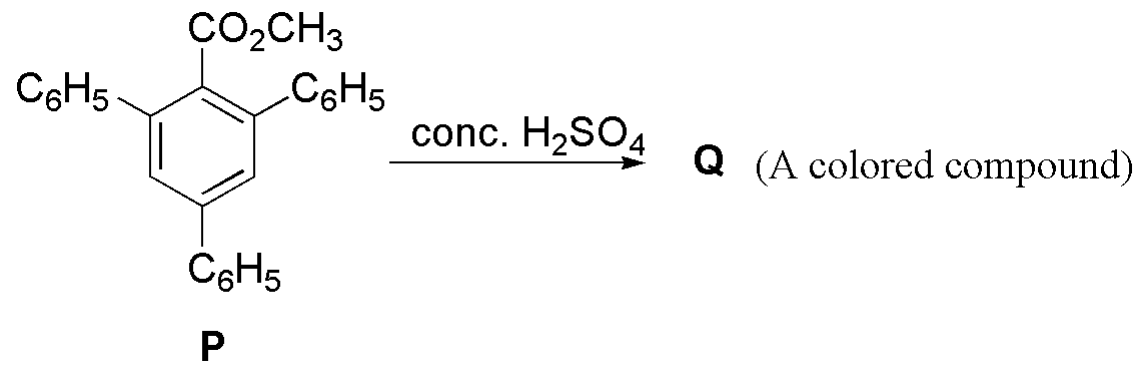
Topics & Concepts
Step-by-Step Solution
To determine the degree of unsaturation (also known as the Index of Hydrogen Deficiency, IHD) of compound , we analyze the structure of the starting compound and the chemical transformation taking place in the presence of concentrated .
Step 1: Degree of Unsaturation of Starting Compound
Compound is -hydroxy--triphenylcyclohexa--dienecarboxylic acid methyl ester. Its structure consists of:
-
Three phenyl rings (): Each phenyl ring contains ring and double bonds.
-
Central 6-membered ring: Contains ring and endocyclic double bonds.
-
Ester group (): Contains carbonyl double bond ().
Summing these contributions gives the total degree of unsaturation for compound :
Alternatively, using the molecular formula of , :
Step 2: Reaction Mechanism with Concentrated
When compound is treated with concentrated , it undergoes a series of acid-catalyzed ionic transformations:
-
Protonation and Dehydration: The hydroxyl group () at is protonated to form a good leaving group (). Loss of a water molecule () generates a highly resonance-stabilized carbocation at .
- Elimination of increases the degree of unsaturation by .
-
First Intramolecular Cyclization: The carbocation at undergoes an intramolecular electrophilic aromatic substitution (EAS) attack onto the ortho-position of an adjacent phenyl group (at ). Subsequent loss of restores aromaticity, yielding a fused 5-membered ring (fluorene derivative).
- Formation of this new ring increases the degree of unsaturation by .
-
Acylium Ion Formation and Second Cyclization: The methyl ester group () at gets protonated under strongly acidic conditions and loses methanol () to form an acylium ion (). This acylium ion undergoes a second intramolecular electrophilic aromatic substitution onto the ortho-position of the phenyl group at , forming a fused polycyclic aromatic ketone.
- Formation of this second fused ring increases the degree of unsaturation by .
-
Aromatization to Form Colored Product : The extended polycyclic system undergoes final aromatization/conjugation to form the deeply colored product with formula .
Step 3: Calculation of Degree of Unsaturation of Compound
Using the molecular formula of the final product ():
Or directly from the change in unsaturation during the reaction:
The degree of unsaturation present in compound is 19.