Critical Temperature Analysis of Superconductor Under Magnetic Fields
Electrical resistance of certain materials, known as superconductors, changes abruptly from a nonzero value to zero as their temperature is lowered below a critical temperature . An interesting property of superconductors is that their critical temperature becomes smaller than if they are placed in a magnetic field, i.e., the critical temperature is a function of the magnetic field strength . The dependence of on is shown in the figure.
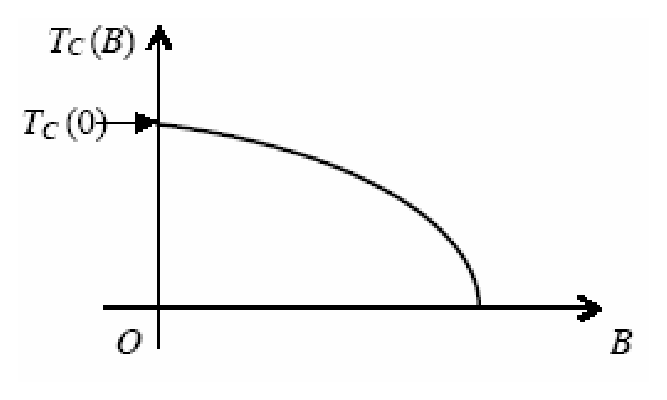
A superconductor has . When a magnetic field of is applied, its decreases to . For this material one can definitely say that when
Options
Topics & Concepts
Step-by-Step Solution
Based on the provided passage and graph, the critical temperature of a superconductor is a strictly monotonically decreasing function of the applied magnetic field strength .
Mathematically, if , then:
We are given the following values for a specific material:
- At , .
- At , .
Now, let us evaluate the given magnetic field values:
Case 1: For
Since , using the strictly monotonic decreasing nature of :
Substituting the known values into the inequality gives:
Since the exact functional form of is not specified, we cannot state an exact numerical value such as (Option A). However, we can definitely guarantee that (Option B).
Case 2: For
Since , monotonicity implies:
Therefore, must be strictly less than , which rules out Option C. Option D states an exact value of , which again cannot be definitively stated without a specific function.
Thus, one can definitely say that when , .
Correct Option: B