Count Liquids Deflected by Charged Comb Stream Test
Consider the following substances in liquid form: .
When a charged comb is brought close to their flowing stream, how many of these liquids exhibit deflection as illustrated in the figure?
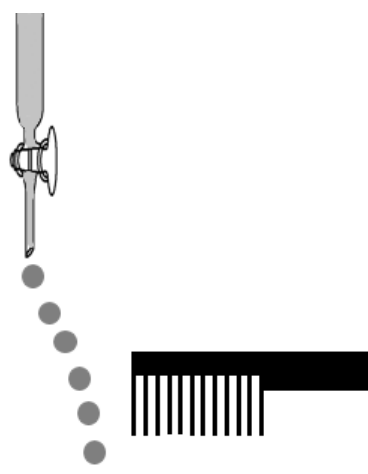
Official Numerical Answer6
Topics & Concepts
Step-by-Step Solution
To determine the number of liquid streams deflected by a charged comb, we use the principle of electrostatic deflection of liquids containing polar molecules.
Principle:
When a charged object (such as a comb) is brought near a stream of a liquid, the electric field generated by the charge creates a non-uniform field.
- Liquids composed of polar molecules (, having a permanent dipole moment) experience an attractive electrostatic force regardless of whether the comb is positively or negatively charged, causing the stream to deflect toward the comb.
- Liquids composed of non-polar molecules () do not possess a permanent dipole moment and do not show observable deflection.
Analysis of the Given Liquids:
-
(Liquid Oxygen):
- A homonuclear diatomic molecule.
- Dipole moment: (Non-polar No deflection).
-
(Liquid Hydrogen Fluoride):
- Heteronuclear diatomic molecule with high electronegativity difference between and .
- Dipole moment: (Polar Deflected).
-
(Water):
- Bent (V-shaped) geometry with lone pairs on oxygen, breaking symmetry.
- Dipole moment: (Polar Deflected).
-
(Liquid Ammonia):
- Trigonal pyramidal geometry with a lone pair on nitrogen.
- Dipole moment: (Polar Deflected).
-
(Hydrogen Peroxide):
- Non-planar open-book structure, leading to a net dipole moment.
- Dipole moment: (Polar Deflected).
-
(Carbon Tetrachloride):
- Highly symmetrical tetrahedral structure ( symmetry) where individual bond dipoles cancel each other out completely.
- Dipole moment: (Non-polar No deflection).
-
(Chloroform):
- Asymmetrical tetrahedral structure where bond dipoles do not cancel out.
- Dipole moment: (Polar Deflected).
-
(Benzene):
- Symmetrical planar hexagonal ring ( symmetry).
- Dipole moment: (Non-polar No deflection).
-
(Chlorobenzene):
- Asymmetric polar molecule due to the electronegative chlorine atom attached to the benzene ring.
- Dipole moment: (Polar Deflected).
Conclusion:
The liquids that exhibit deflection are those with :
Total number of liquids showing deflection .