Calculate Time for Relative Motion Near Collision of Two Airplanes
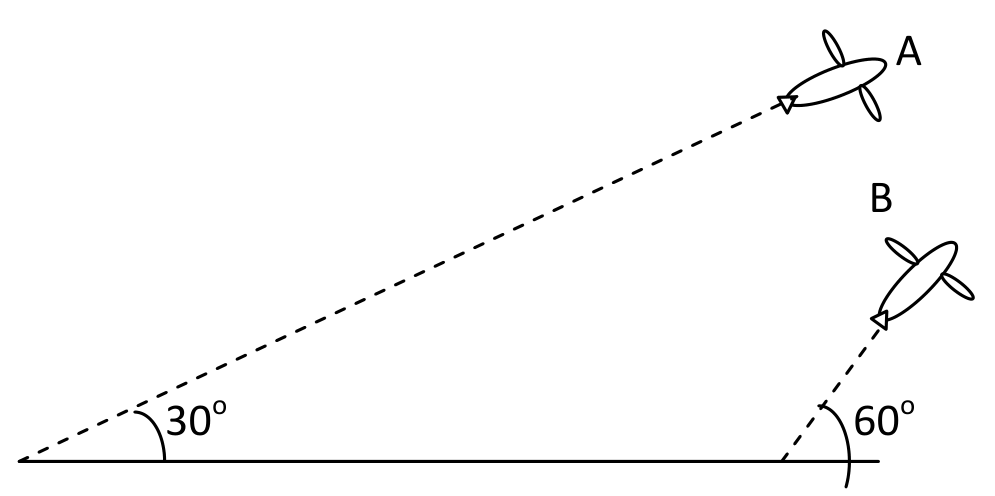
Airplanes A and B fly with constant speed within the same vertical plane at inclination angles and relative to horizontal, respectively (see figure). Speed of A is . At instant , an observer situated on A finds B at a separation distance of . The observer perceives B to be traveling with constant speed perpendicular to A's line of motion. If at , aircraft A narrowly escapes colliding with B, the value of in seconds is
Topics & Concepts
Step-by-Step Solution
To find the time at which airplane A narrowly escapes colliding with airplane B, we can analyze the motion using a relative reference frame attached to airplane A.
Step 1: Velocity Analysis in Vector Form
Let the horizontal direction be the x-axis () and the vertical direction be the y-axis ().
The velocity of airplane A, flying at an angle of relative to the horizontal with speed , is given by:
The velocity of airplane B, flying at an angle of relative to the horizontal with speed , is given by:
Step 2: Relative Velocity
The velocity of airplane B relative to airplane A is:
Step 3: Utilizing the Perpendicularity Condition
An observer on airplane A sees airplane B moving perpendicular to A's direction of motion. Therefore, the dot product of and must be zero:
Alternatively, resolving the component of along the direction of motion of A:
Step 4: Magnitude of Relative Velocity
The magnitude of the component of relative velocity perpendicular to A's line of motion is:
Step 5: Calculation of Time
At , the initial distance between A and B in the relative frame is . For a potential collision (or a near miss) at , B travels this relative distance along the line of relative motion at constant relative speed :