Average Speed of Charged Particle in Split Magnetic Fields
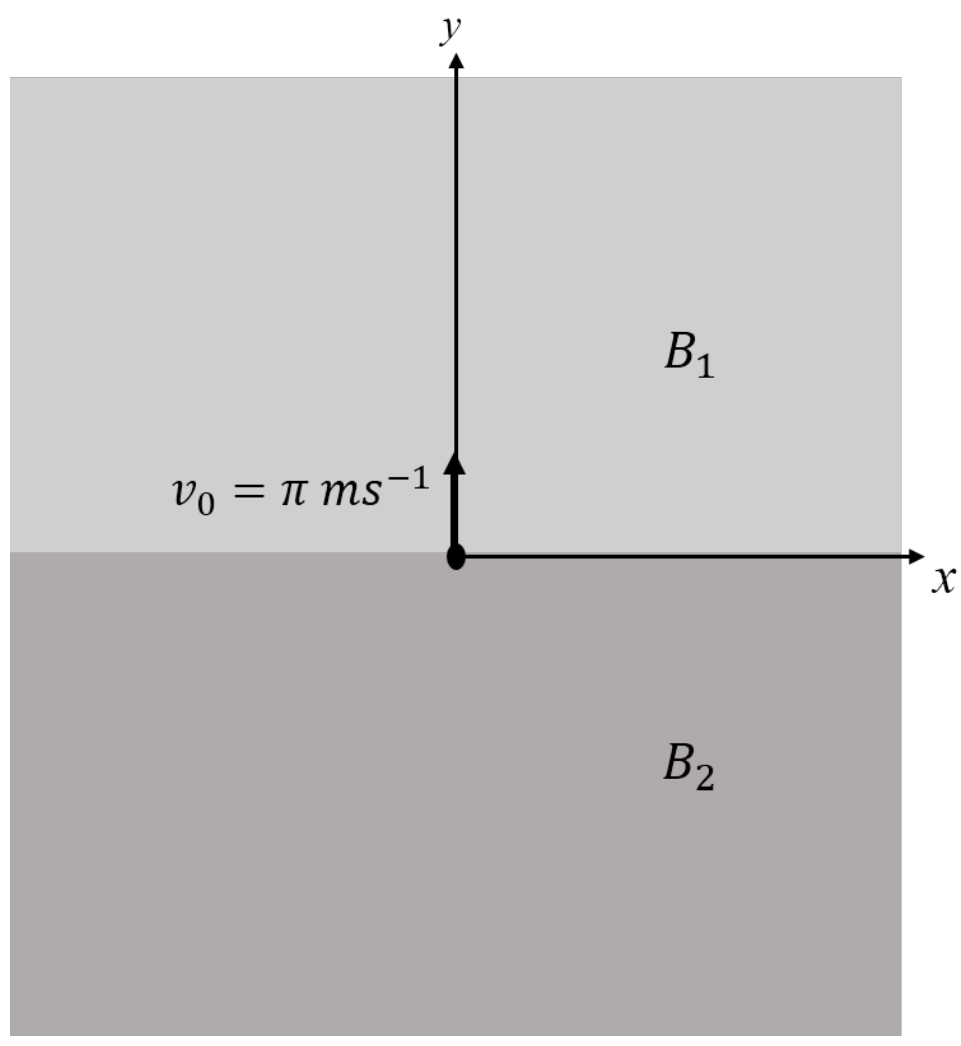
Consider the -plane where the region has a uniform magnetic field and the region has another uniform magnetic field . A positively charged particle is projected from the origin along the positive -axis with speed at , as shown in the figure. Neglect gravity in this problem. Let be the instant when the particle crosses the -axis from below for the first time. If , the average speed of the particle, in , along the -axis in the time interval is __________.
Topics & Concepts
Step-by-Step Solution
To find the average speed of the particle along the -axis in the time interval , we first analyze the motion of the particle in both regions.
1. Motion in the Region :
The particle with charge and mass enters the region at the origin with initial velocity . The magnetic field in this region is .
The magnetic Lorentz force acting on the particle is:
Since the force is perpendicular to the velocity and initially directed along the positive -axis, the particle executes uniform circular motion in the -plane with radius :
The particle traces a semicircle in the upper half-plane:
- It starts at and reaches the -axis again at .
- The time spent in the upper half-plane is:
- At , the particle is at with velocity .
2. Motion in the Region :
The particle enters the region at with velocity . The magnetic field in this region is .
The magnetic Lorentz force acting on the particle is:
This force is directed along the negative -axis, causing the particle to trace another semicircle in the lower half-plane with radius :
- The particle curves towards the negative -direction and crosses the -axis from below at:
- The time spent in this region is:
Thus, the total time until the particle crosses the -axis from below for the first time is:
3. Average Speed along the -axis:
The speed along the -axis at any instant is . The total distance traveled by the particle along the -direction is:
-
In the time interval , the -coordinate increases monotonically from to , so the distance traveled along the -axis is:
-
In the time interval , the -coordinate decreases monotonically from to , so the distance traveled along the -axis is:
Thus, the total distance traveled along the -axis is:
The average speed along the -axis is given by:
Given :