Aqueous Reaction Scheme of Potassium Ferricyanide and Zinc Sulfate
For the given aqueous reactions, which of the statement(s) is (are) true ?
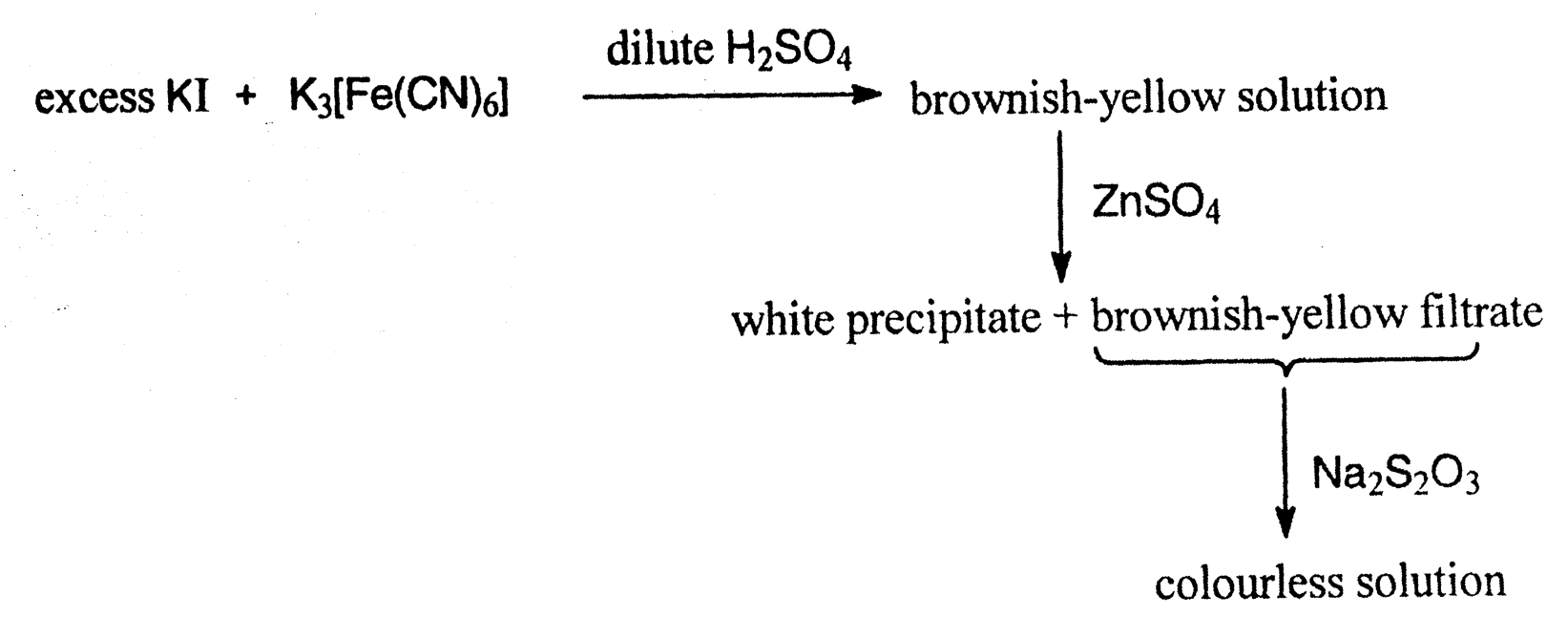
Options
The first reaction is a redox reaction.
White precipitate is .
Addition of filtrate to starch solution gives blue colour.
White precipitate is soluble in solution.
Topics & Concepts
Step-by-Step Solution
To determine the correctness of each statement, we analyze the reaction sequence step by step:
-
First Reaction: Potassium ferricyanide () contains iron in the oxidation state, which acts as an oxidizing agent in an acidic medium (). When reacted with excess potassium iodide (), iodide ions () are oxidized to iodine (), while ferricyanide is reduced to ferrocyanide (): In the presence of excess , iodine dissolves to form the triiodide ion (), which gives the solution its characteristic brownish-yellow color: Since this reaction involves a change in oxidation states ( and ), it is a redox reaction.
Therefore, (A) is true. -
Precipitation with : When zinc sulfate () is added to the mixture, ions react with the ferrocyanide ions () to precipitate zinc ferrocyanide, which is white: The precipitate is a salt of ferrocyanide (), not ferricyanide (, which contains ).
Therefore, (B) is false. -
Filtrate Reaction with Starch: The brownish-yellow filtrate contains the liberated iodine in the form of (which also decolorizes upon the addition of sodium thiosulfate, , due to reduction to iodide and formation of tetrathionate): Iodine gives an intensely colored blue inclusion complex when added to starch solution.
Therefore, (C) is true. -
Solubility of the White Precipitate in : Zinc is an amphoteric metal. When sodium hydroxide () is added to the white precipitate of zinc ferrocyanide, it dissolves to form the soluble sodium tetrahydroxozincate(II) complex along with ferrocyanide ions: Therefore, the precipitate is soluble in solution.
Therefore, (D) is true.
Correct Answer: A, C, D