Amplitude of Point Between Two Springs in Simple Harmonic Motion
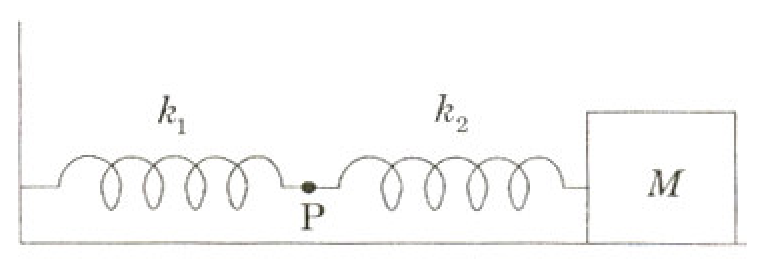
The mass shown in the figure oscillates in simple harmonic motion with amplitude . The amplitude of the point is
Options
Topics & Concepts
Step-by-Step Solution
To find the amplitude of the point , we analyze the system of two massless springs connected in series:
-
System Configuration:
- Spring 1 has a spring constant and is connected between the rigid wall and the point .
- Spring 2 has a spring constant and is connected between the point and the mass .
- The mass undergoes simple harmonic motion with amplitude .
-
Equation of Motion for Point :
Let the displacements from the respective equilibrium positions at any instant be:- for the mass , where the maximum value of is the amplitude .
- for the point .
Since the springs are ideal and massless, the net force on the junction point must be zero at all times:
The restoring force exerted by spring 1 on point is:
The restoring force exerted by spring 2 on point is:
Equating these forces gives:
-
Solving for the Displacement and Amplitude of Point :
Rearranging the equation:
Since the mass oscillates with an amplitude of (so ), the amplitude of the point is:
Therefore, the correct option is (D).