Acidic Hydrolysis Rate of Substituted Trityl Ether Derivatives
The rate of acid-catalyzed hydrolysis of the given ether occurs most rapidly when:
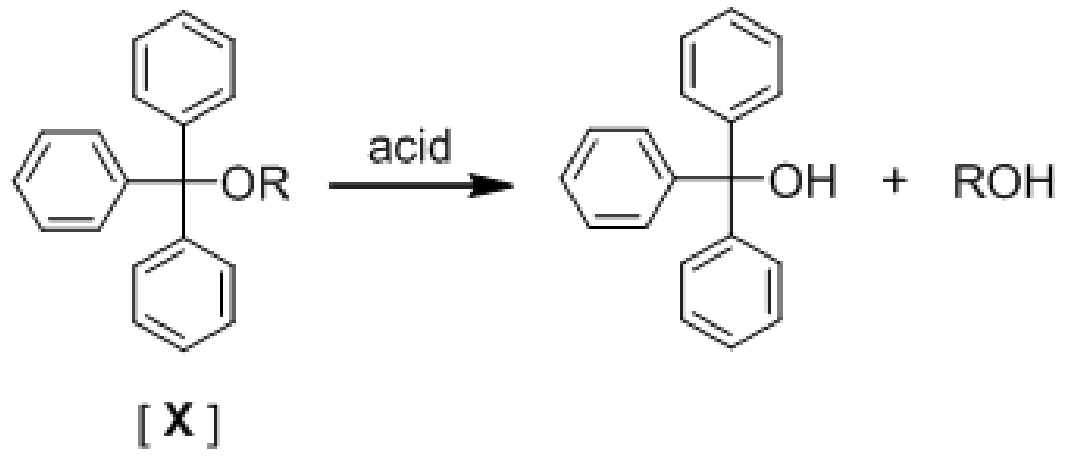
Options
a methyl group replaces one phenyl ring.
a -methoxyphenyl group replaces one phenyl ring.
two -methoxyphenyl groups replace two phenyl rings.
no structural modification is done to .
Step-by-Step Solution
The rate of acid-catalyzed hydrolysis of an ether depends strongly on the stability of the intermediate formed during the reaction.
1. Reaction Mechanism:
The acid-catalyzed hydrolysis of the trityl ether derivative () proceeds via an mechanism due to the steric hindrance and the high stability of the triarylmethyl cation formed as an intermediate:
-
Protonation of Ether:
-
Heterolytic Cleavage (Rate-Determining Step, RDS):
-
Nucleophilic Attack by Water:
2. Factors Affecting the Reaction Rate:
Since step 2 is the rate-determining step, any factor that increases the stability of the carbocation intermediate () lowers the activation energy () of the transition state, thereby accelerating the rate of hydrolysis.
3. Evaluation of Options:
-
Replacing a phenyl ring with a methyl group (Option A): A methyl group stabilizes a carbocation via hyperconjugation and inductive effects (), whereas a phenyl ring stabilizes it via extensive -delocalization (resonance). Replacing a phenyl ring with a methyl group reduces resonance stabilization, making the carbocation less stable and decreasing the reaction rate.
-
Original Molecule (Option D): The triphenylmethyl (trityl) carbocation, , is stabilized by resonance across three phenyl rings.
-
Replacing one phenyl group with a -methoxyphenyl group (Option B): The -methoxy () substituent is a strong electron-donating group through its mesomeric effect (). The lone pair of electrons on the oxygen atom delocalizes effectively into the ring and onto the central carbocation: This significant stabilization increases the carbocation stability relative to .
-
Replacing two phenyl groups with two -methoxyphenyl groups (Option C): Having two -methoxyphenyl groups introduces two strong electron-donating groups. The additive resonance contribution of both methoxy groups stabilizes the positive charge on the central carbon atom to an even greater extent than a single -methoxyphenyl group.
Conclusion:
The carbocation formed when two phenyl groups are replaced by two -methoxyphenyl groups is the most stable among all the choices, leading to the lowest activation energy and the fastest rate of hydrolysis.
Thus, the correct option is C.