JEE Challenger
More from Alcohols, Phenols and Ethers

Weight Percentage of Hydrogen in Picric Acid Synthesis

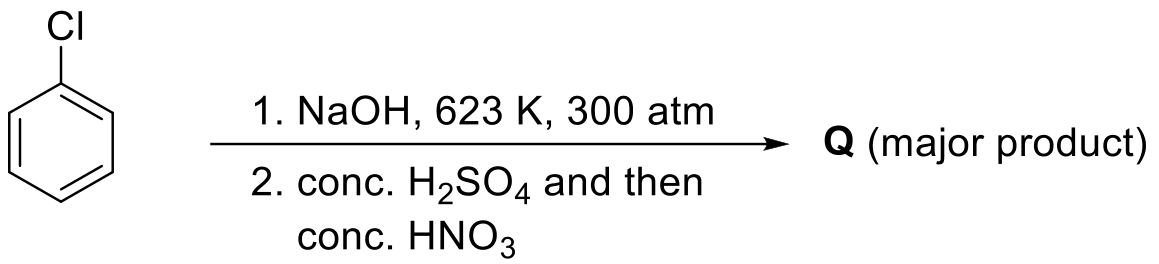
The weight percentage of hydrogen in Q\mathbf{Q}, formed in the following reaction sequence, is ____________.

[Given: Atomic mass of H=1,C=12,N=14,O=16,S=32,Cl=35\text{H} = 1, \text{C} = 12, \text{N} = 14, \text{O} = 16, \text{S} = 32, \text{Cl} = 35]

Question Diagram 1
Official Numerical Answer1.31

Step-by-Step Solution

To determine the weight percentage of hydrogen in product Q\mathbf{Q}, we analyze the given two-step reaction sequence:

  1. Step 1: Conversion of Chlorobenzene to Phenol Chlorobenzene undergoes nucleophilic aromatic substitution when treated with NaOH\text{NaOH} at high temperature (623 K623\text{ K}) and high pressure (300 atm300\text{ atm}) (Dow's Process) to yield sodium phenoxide, which upon neutralization gives phenol (C6H5OH\text{C}_6\text{H}_5\text{OH}).

    C6H5Cl→2. H+1. NaOH, 623 K,300 atmC6H5OH\text{C}_6\text{H}_5\text{Cl} \xrightarrow[\text{2. H}^+]{\text{1. NaOH, } 623\text{ K}, 300\text{ atm}} \text{C}_6\text{H}_5\text{OH}

  2. Step 2: Conversion of Phenol to Product Q\mathbf{Q} When phenol is treated first with concentrated H2SO4\text{H}_2\text{SO}_4, it undergoes sulfonation to form phenol-2,4-disulfonic acid. Subsequent treatment with concentrated HNO3\text{HNO}_3 results in nitration along with desulfonation to produce 2,4,6-trinitrophenol (commonly known as Picric acid) as the major product Q\mathbf{Q}.

    C6H5OH→1. conc. H2SO4, 2. conc. HNO3C6H2(NO2)3OH(Q)\text{C}_6\text{H}_5\text{OH} \xrightarrow{\text{1. conc. H}_2\text{SO}_4, \text{ 2. conc. HNO}_3} \text{C}_6\text{H}_2(\text{NO}_2)_3\text{OH} \quad (\mathbf{Q})

  3. Molecular Mass Calculation for Compound Q\mathbf{Q} (C6H3N3O7\text{C}_6\text{H}_3\text{N}_3\text{O}_7):

    • Carbon (C\text{C}): 6×12=72 g/mol6 \times 12 = 72\text{ g/mol}
    • Hydrogen (H\text{H}): 3×1=3 g/mol3 \times 1 = 3\text{ g/mol}
    • Nitrogen (N\text{N}): 3×14=42 g/mol3 \times 14 = 42\text{ g/mol}
    • Oxygen (O\text{O}): 7×16=112 g/mol7 \times 16 = 112\text{ g/mol}

    Molar mass of Q=72+3+42+112=229 g/mol\text{Molar mass of } \mathbf{Q} = 72 + 3 + 42 + 112 = 229\text{ g/mol}

  4. Weight Percentage of Hydrogen:

    Weight % of H=(Mass of HMolar mass of Q)×100\text{Weight \% of H} = \left( \frac{\text{Mass of H}}{\text{Molar mass of } \mathbf{Q}} \right) \times 100

    Weight % of H=3229×100≈1.31%\text{Weight \% of H} = \frac{3}{229} \times 100 \approx 1.31\%

Thus, the weight percentage of hydrogen in Q\mathbf{Q} is 1.31.