JEE Challenger
More from Organic Chemistry - Basic Principles

Volume of Sulfuric Acid Required in Kjeldahl Estimation of Nitrogen

Comprehension Passage

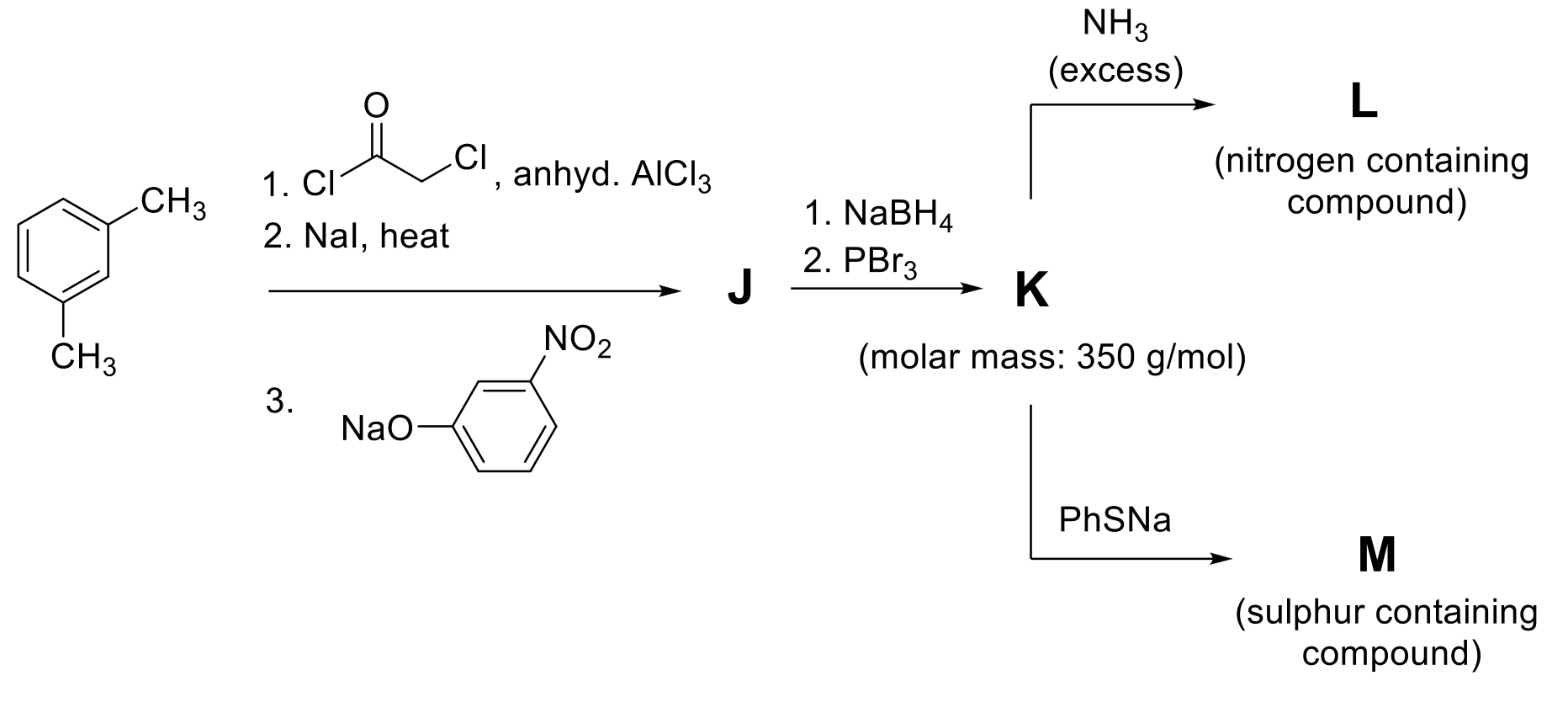
Consider the following reaction sequence in which J, K, L and M are the major products.

Given:
Atomic mass (in amu): H:1,C:12,N:14,O:16,S:32,Br:80,Ba:137\text{H}: 1, \text{C}: 12, \text{N}: 14, \text{O}: 16, \text{S}: 32, \text{Br}: 80, \text{Ba}: 137

The volume of 1 M1\text{ M} aqueous H2SO4\text{H}_2\text{SO}_4 required to completely neutralize the ammonia evolved from 5.72 g5.72\text{ g} of L in Kjeldahl's method of nitrogen estimation is ______ mL\text{mL}.

Question Diagram 1
Official Numerical Answer10

Step-by-Step Solution

To determine the volume of 1 M1\text{ M} aqueous H2SO4\text{H}_2\text{SO}_4 required to neutralize the ammonia evolved from compound L, we first deduce the chemical structures and molecular formulas of the compounds in the reaction sequence.


Step 1: Identification of Reaction Sequence Products

  1. Formation of Compound J:

    • Friedel-Crafts Acylation: Reaction of mm-xylene (1,31,3-dimethylbenzene) with chloroacetyl chloride (Cl-CH2CO-Cl\text{Cl-CH}_2-\text{CO-Cl}) in the presence of anhydrous AlCl3\text{AlCl}_3 yields 22-chloro-11-(2,42,4-dimethylphenyl)ethan-11-one as the major electrophilic substitution product at the 44-position.
    • Finkelstein Reaction: Treatment with NaI\text{NaI} and heat substitutes the chlorine atom with iodine to yield 22-iodo-11-(2,42,4-dimethylphenyl)ethan-11-one.
    • Nucleophilic Substitution: Reaction with sodium 33-nitrophenoxide (NaOC6H43-NO2\text{NaO}-\text{C}_6\text{H}_4-3\text{-NO}_2) substitutes the iodine to give product J: J=(2,4-(CH3)2C6H3)C(=O)CH2OC6H4(3-NO2)\mathbf{J} = (2,4\text{-(CH}_3)_2\text{C}_6\text{H}_3)-\text{C}(=\text{O})-\text{CH}_2-\text{O}-\text{C}_6\text{H}_4(3\text{-NO}_2)
  2. Formation of Compound K:

    • Reduction of the carbonyl group of J using NaBH4\text{NaBH}_4 forms a secondary alcohol.
    • Treatment with PBr3\text{PBr}_3 converts the alcohol into a benzylic bromide, yielding K: K=(2,4-(CH3)2C6H3)CH(Br)CH2OC6H4(3-NO2)\mathbf{K} = (2,4\text{-(CH}_3)_2\text{C}_6\text{H}_3)-\text{CH}(\text{Br})-\text{CH}_2-\text{O}-\text{C}_6\text{H}_4(3\text{-NO}_2)

    Verification of Molar Mass of K:

    • Molecular formula of K\mathbf{K}: C16H16BrNO3\text{C}_{16}\text{H}_{16}\text{BrNO}_3
    • Molar Mass of K=(16×12)+(16×1)+80+14+(3×16)=192+16+80+14+48=350 g/mol\mathbf{K} = (16 \times 12) + (16 \times 1) + 80 + 14 + (3 \times 16) = 192 + 16 + 80 + 14 + 48 = 350\text{ g/mol} (Matches the given molar mass).
  3. Formation of Compound L:

    • Nucleophilic substitution of the bromide group in K with excess ammonia (NH3\text{NH}_3) yields the primary amine L: L=(2,4-(CH3)2C6H3)CH(NH2)CH2OC6H4(3-NO2)\mathbf{L} = (2,4\text{-(CH}_3)_2\text{C}_6\text{H}_3)-\text{CH}(\text{NH}_2)-\text{CH}_2-\text{O}-\text{C}_6\text{H}_4(3\text{-NO}_2)

    Molar Mass of L:

    • Molecular formula of L\mathbf{L}: C16H18N2O3\text{C}_{16}\text{H}_{18}\text{N}_2\text{O}_3
    • Molar Mass of L=(16×12)+(18×1)+(2×14)+(3×16)=192+18+28+48=286 g/mol\mathbf{L} = (16 \times 12) + (18 \times 1) + (2 \times 14) + (3 \times 16) = 192 + 18 + 28 + 48 = 286\text{ g/mol}

Step 2: Estimation of Ammonia Evolved via Kjeldahl's Method

In Kjeldahl's method:

  • Nitrogen present in nitro groups (NO2-\text{NO}_2) is not converted into ammonium sulfate (NH3\text{NH}_3) under standard digestion conditions.
  • Only the amine nitrogen (NH2-\text{NH}_2) is quantitatively converted to ammonia (NH3\text{NH}_3).

Thus, 1 mole1\text{ mole} of compound L yields 1 mole1\text{ mole} of NH3\text{NH}_3.

Moles of L=Given MassMolar Mass=5.72 g286 g/mol=0.02 mol\text{Moles of } \mathbf{L} = \frac{\text{Given Mass}}{\text{Molar Mass}} = \frac{5.72\text{ g}}{286\text{ g/mol}} = 0.02\text{ mol}

Moles of NH3 evolved=0.02 mol\text{Moles of } \text{NH}_3 \text{ evolved} = 0.02\text{ mol}


Step 3: Neutralization with H2SO4\text{H}_2\text{SO}_4

The neutralization reaction between ammonia and sulfuric acid is given by: 2NH3+H2SO4(NH4)2SO42\text{NH}_3 + \text{H}_2\text{SO}_4 \rightarrow (\text{NH}_4)_2\text{SO}_4

  • Moles of H2SO4\text{H}_2\text{SO}_4 required: Moles of H2SO4=12×Moles of NH3=0.022=0.01 mol\text{Moles of } \text{H}_2\text{SO}_4 = \frac{1}{2} \times \text{Moles of } \text{NH}_3 = \frac{0.02}{2} = 0.01\text{ mol}

  • Volume of 1 M1\text{ M} H2SO4\text{H}_2\text{SO}_4 required: Volume (in L)=MolesMolarity=0.01 mol1 M=0.01 L=10 mL\text{Volume (in L)} = \frac{\text{Moles}}{\text{Molarity}} = \frac{0.01\text{ mol}}{1\text{ M}} = 0.01\text{ L} = 10\text{ mL}


Final Answer

The volume of 1 M1\text{ M} aqueous H2SO4\text{H}_2\text{SO}_4 required is 10 mL\text{mL}.

Volume of Sulfuric Acid Required in Kjeldahl Estimation of Nitrogen | Chemistry PYQ Solution - JEE Challenger