Voltage Developed Across Wheatstone Bridge Due to Resistance Temperature Change
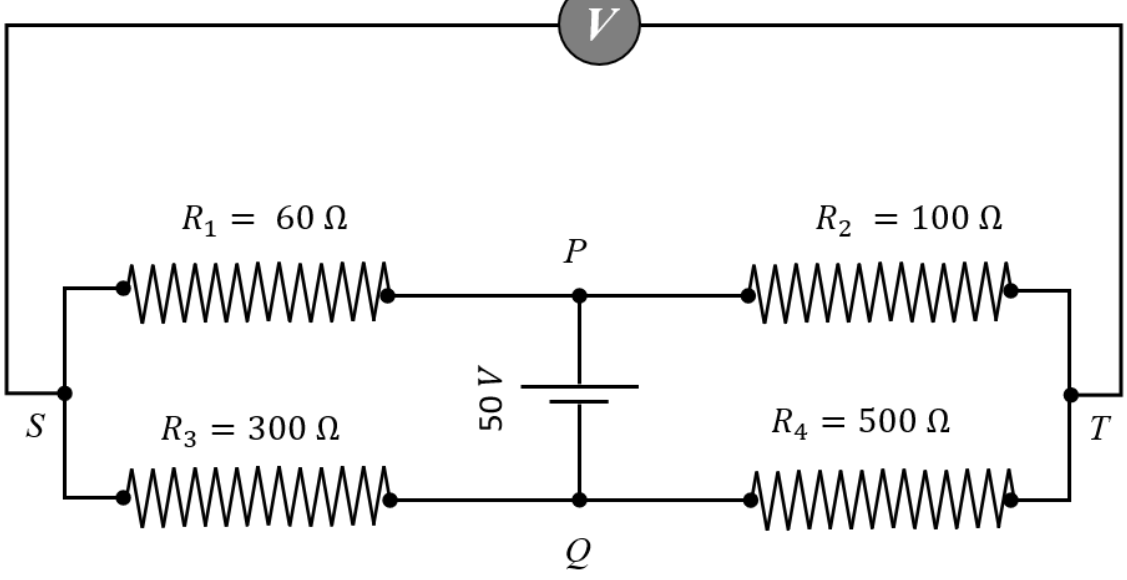
Under the balanced condition, the resistance values of the four arms of a Wheatstone bridge are depicted in the given figure. The resistor R3 possesses a temperature coefficient of 0.0004∘C−1. If the temperature of R3 is raised by 100∘C, calculate the magnitude of the voltage developed between terminals S and T in volts.
To calculate the magnitude of the voltage developed between terminals S and T, we first analyze the potential distribution in the circuit.
1. Circuit Topology and Initial Parameters
From the circuit diagram:
Battery voltage applied between terminals P and Q: VPQ=50 V. Let potential at terminal Q be VQ=0 V, so potential at terminal P is VP=50 V.
R1=60Ω is connected between node P and node S.
R3=300Ω is connected between node Q and node S.
R2=100Ω is connected between node P and node T.
R4=500Ω is connected between node Q and node T.
Initially, the bridge is balanced because:
R2R1=10060=53andR4R3=500300=53
2. Change in Resistance of R3
When the temperature of resistor R3 is raised by ΔT=100∘C, its resistance changes according to the temperature coefficient of resistance α=0.0004∘C−1:
Since R2 and R4 remain unchanged, the potential at node T is determined by the voltage divider rule across the branch P−T−Q:
VT=VQ+(VP−VQ)⋅R2+R4R4VT=50×100+500500=50×600500=50×65=6250 V=3125 V
New Potential at Terminal S (VS′):
Using the new resistance value R3′=312Ω, the potential at node S is given by:
VS′=VQ+(VP−VQ)⋅R1+R3′R3′VS′=50×60+312312=50×372312
Simplifying the fraction 372312 by dividing the numerator and denominator by 12:
372312=3126
Thus,
VS′=50×3126=311300 V
4. Voltage Developed Between Terminals S and T
The potential difference VST between terminals S and T is:
VST=∣VS′−VT∣=311300−3125
Taking the common denominator (31×3=93):
VST=931300×3−125×31VST=933900−3875=9325 V
Evaluating the numerical value:
VST≈0.2688 V
Rounding off to two decimal places, the magnitude of the voltage developed is 0.27 V (or within the range 0.26 to 0.28).