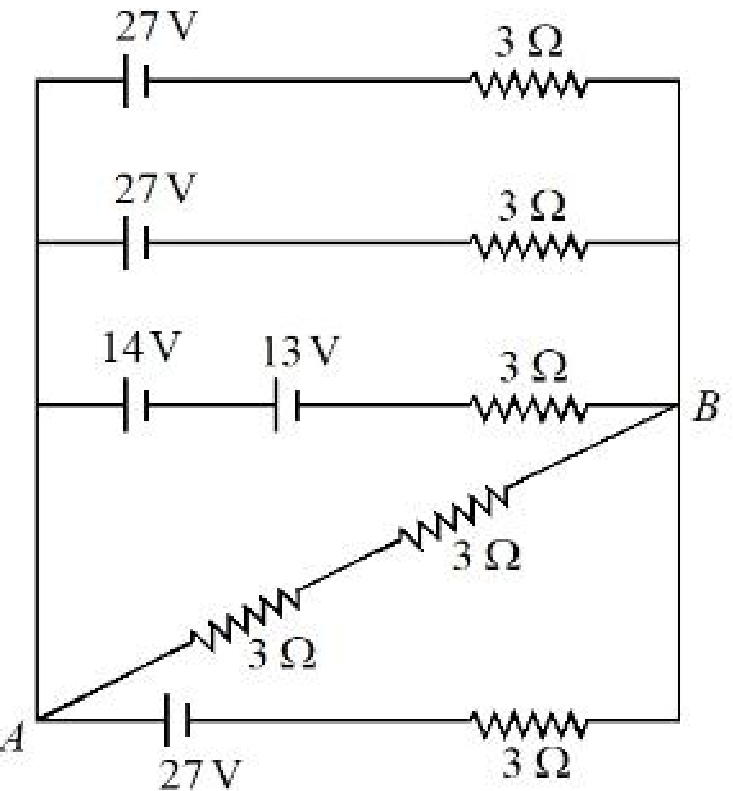
To find the potential difference (voltage) VAB between points A and B and the current I passing through the branch containing the passive resistors between A and B, we can model the circuit using Millman's Theorem for parallel branches connected across nodes A and B.
1. Identification of Parallel Branches
By observing the circuit diagram:
- Node A corresponds to the entire left vertical bus wire.
- Node B corresponds to the entire right vertical bus wire.
There are 5 parallel branches connected between nodes A and B:
- Branch 1 (Top): Battery of E1=27 V in series with resistance R1=3 Ω.
- Branch 2: Battery of E2=27 V in series with resistance R2=3 Ω.
- Branch 3: Two batteries in series giving E3=14 V+13 V=27 V with resistance R3=3 Ω.
- Branch 4 (Diagonal Branch): No voltage source (E4=0 V) and two 3 Ω resistors in series, giving a total resistance of R4=3 Ω+3 Ω=6 Ω.
- Branch 5 (Bottom): Battery of E5=27 V in series with resistance R5=3 Ω.
2. Calculation of Voltage VAB
According to Millman's Theorem, the potential difference VAB=VA−VB across two common nodes is given by:
VAB=∑k=1nRk1∑k=1nRkEk
Calculating the numerator ∑RkEk:
R1E1=327=9 A
R2E2=327=9 A
R3E3=327=9 A
R4E4=60=0 A
R5E5=327=9 A
∑k=15RkEk=9+9+9+0+9=36 A
Calculating the denominator ∑Rk1:
∑k=15Rk1=31+31+31+61+31=4(31)+61=34+61=69=23 Ω−1
Substituting these values back into Millman's formula:
VAB=2336=24 V
3. Calculation of Current I
execution The current I flowing through the diagonal branch containing the two 3 Ω resistors (total resistance R4=6 Ω) is given by Ohm's Law:
I=R4VAB=6 Ω24 V=4 A
Conclusion
- Voltage (VAB): 24 V
- Current (I): 4 A
Thus, the correct option is B.