Vibration Frequency and Nodes of Two Joined Composite Strings
Two uniform strings of mass per unit length and , and length and , respectively, are joined at point O, and tied at two fixed ends P and Q, as shown in the figure. The strings are under a uniform tension . If we define the frequency , which of the following statement(s) is(are) correct?
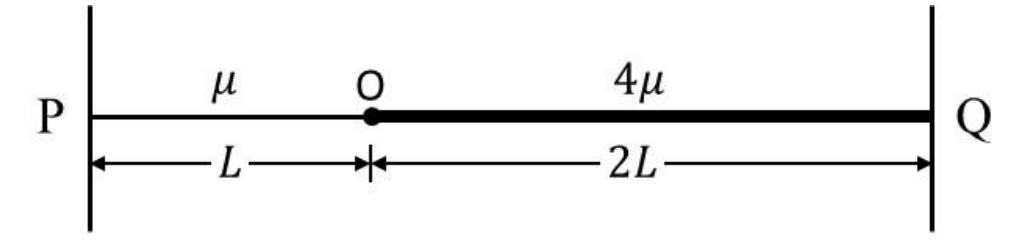
Options
With a node at O, the minimum frequency of vibration of the composite string is .
With an antinode at O, the minimum frequency of vibration of the composite string is .
When the composite string vibrates at the minimum frequency with a node at O, it has 6 nodes, including the end nodes.
No vibrational mode with an antinode at O is possible for the composite string.
Topics & Concepts
Step-by-Step Solution
To determine the correct options, we analyze the wave propagation and boundary conditions for the composite string.
1. Properties of the String Segments
-
Left segment (PO):
- Length
- Linear mass density
- Tension
- Wave speed
-
Right segment (OQ):
- Length
- Linear mass density
- Tension
- Wave speed
The characteristic frequency is given as:
2. Analysis of Node at Point O (Options A and C)
If point O is a node, then segment PO and segment OQ vibrate independently as strings fixed at both ends (P & O for PO, and O & Q for OQ).
-
For segment PO with fixed ends at and , the possible frequencies are:
-
For segment OQ with fixed ends at and , the possible frequencies are:
For the composite string to oscillate in a standing wave mode, both segments must vibrate at the same frequency :
-
Minimum Frequency: Taking the smallest positive integer , we get . Therefore, Option A is correct.
-
Number of Nodes at Minimum Frequency:
- For in PO, there are nodes (at P and O).
- For in OQ, there are nodes (at O, 3 interior nodes, and Q).
- Since point O is shared by both segments, the total number of distinct nodes is: Therefore, Option C is correct.
3. Analysis of Antinode at Point O (Options B and D)
An antinode occurs at a position where the derivative of the standing wave amplitude with respect to position is zero ().
Set up the standing wave equation for both segments:
-
Segment PO ( measured from P):
-
Segment OQ ( measured from Q towards O):
For point O ( and ) to be an antinode:
Since , we substitute :
However, for any integer . Thus, and can never be satisfied simultaneously.
Hence, no vibrational mode with an antinode at O is physically possible. Therefore, Option D is correct, and Option B is incorrect.
Conclusion
The correct options are A, C, and D.