Vertical Velocity Component Following Elastic Collision on Incline
Paragraph for Question Nos. 44 to 46
A small block of mass moves on a frictionless surface of an inclined plane, as shown in figure.
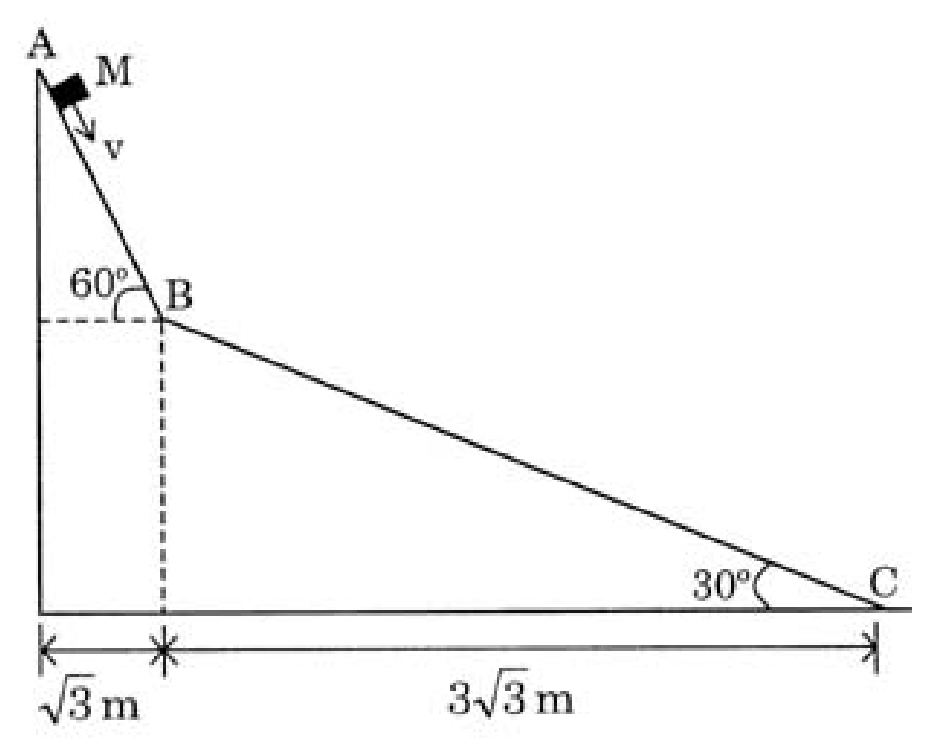
The angle of the incline suddenly changes from to at point . The block is initially at rest at . Assume that collisions between the block and the incline are totally inelastic ().
If collision between the block and the incline is completely elastic, then the vertical (upward) component of the velocity of the block at point , immediately after it strikes the second incline is
Options
Topics & Concepts
Step-by-Step Solution
To find the vertical component of the velocity immediately after the elastic collision at point , we first determine the speed and direction of the block just before it strikes the second incline.
1. Motion along the first incline ():
From the given geometry:
- The angle of the first incline with the horizontal is .
- The horizontal span of this section is .
The vertical height through which the block falls from to is:
Using conservation of mechanical energy, the speed of the block just before reaching point is:
The direction of this velocity vector is along the first incline, which is directed at an angle of below the horizontal:
2. Elastic collision with the second incline:
The second incline makes an angle of below the horizontal.
Let us define a coordinate system with respect to the second incline:
- Parallel to the incline (downwards):
- Perpendicular to the incline (outwards/upwards):
The angle between the incoming velocity vector and the second incline's surface is:
The velocity components just before the collision are:
- Parallel to the second incline:
- Perpendicular to the second incline:
For a completely elastic collision ():
- The component parallel to the surface remains unchanged:
- The component perpendicular to the surface reverses its direction:
3. Vertical component of the velocity immediately after impact:
The velocity vector immediately after the collision is given by:
Taking the vertical (upward, ) component:
Alternatively, by the law of reflection, since the incoming velocity vector makes an angle of with the second incline (which is itself at an angle of with the horizontal), the reflected velocity vector will make an angle of:
with the horizontal. Thus, the velocity of the block immediately after the elastic collision is entirely horizontal, meaning its vertical component is zero.
Therefore, the correct option is C.