JEE Challenger
More from System of Particles and Rotational Motion

Velocity Relations for Points on Rolling Sphere

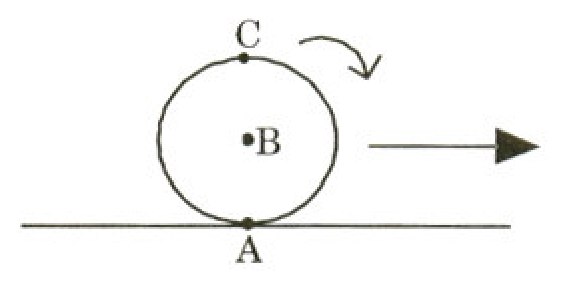
A sphere is rolling without slipping on a fixed horizontal plane surface. In the figure, A\mathrm{A} is the point of contact, B\mathrm{B} is the centre of the sphere and C\mathrm{C} is its topmost point. Then,

Diagram 0

Options

A

V⃗C−V⃗A=2(V⃗B−V⃗C)\vec{V}_C - \vec{V}_A = 2\left(\vec{V}_B - \vec{V}_C\right)

B

V⃗C−V⃗B=V⃗B−V⃗A\vec{V}_C - \vec{V}_B = \vec{V}_B - \vec{V}_A

Correct
C

∣V⃗C−V⃗A∣=2∣V⃗B−V⃗C∣\left|\vec{V}_C - \vec{V}_A\right| = 2\left|\vec{V}_B - \vec{V}_C\right|

Correct
D

∣V⃗C−V⃗A∣=4∣V⃗B∣\left|\vec{V}_C - \vec{V}_A\right| = 4\left|\vec{V}_B\right|

Step-by-Step Solution

To find the correct relations between the velocities of points A\mathrm{A}, B\mathrm{B}, and C\mathrm{C}, we consider a sphere of radius RR rolling without slipping on a fixed horizontal surface.

Let the sphere move in the positive xx-direction with the velocity of its centre of mass (point B\mathrm{B}) given by:
V⃗B=vi^\vec{V}_B = v \hat{i}

For pure rolling without slipping on a stationary ground, the angular velocity ω⃗\vec{\omega} of the sphere is clockwise (in the −k^-\hat{k} direction):
ω⃗=−ωk^=−vRk^\vec{\omega} = -\omega \hat{k} = -\frac{v}{R} \hat{k}

The velocity of any point P\mathrm{P} on the sphere is given by the kinematic relation:
V⃗P=V⃗B+ω⃗×r⃗P/B\vec{V}_P = \vec{V}_B + \vec{\omega} \times \vec{r}_{P/B}

  1. Velocity of the point of contact A\mathrm{A}:
    The position vector of A\mathrm{A} relative to the centre B\mathrm{B} is r⃗A/B=−Rj^\vec{r}_{A/B} = -R \hat{j}.
    V⃗A=vi^+(−ωk^)×(−Rj^)=vi^−ωRi^\vec{V}_A = v\hat{i} + (-\omega\hat{k}) \times (-R\hat{j}) = v\hat{i} - \omega R\hat{i}
    Since the sphere rolls without slipping, v=ωRv = \omega R, which gives:
    V⃗A=0⃗\vec{V}_A = \vec{0}

  2. Velocity of the centre B\mathrm{B}:
    V⃗B=vi^\vec{V}_B = v\hat{i}

  3. Velocity of the topmost point C\mathrm{C}:
    The position vector of C\mathrm{C} relative to the centre B\mathrm{B} is r⃗C/B=Rj^\vec{r}_{C/B} = R \hat{j}.
    V⃗C=vi^+(−ωk^)×(Rj^)=vi^+ωRi^=2vi^=2V⃗B\vec{V}_C = v\hat{i} + (-\omega\hat{k}) \times (R\hat{j}) = v\hat{i} + \omega R\hat{i} = 2v\hat{i} = 2\vec{V}_B

Now, we evaluate each of the given options:

  • Option (A):
    V⃗C−V⃗A=2vi^−0⃗=2vi^\vec{V}_C - \vec{V}_A = 2v\hat{i} - \vec{0} = 2v\hat{i}
    2(V⃗B−V⃗C)=2(vi^−2vi^)=−2vi^2\left(\vec{V}_B - \vec{V}_C\right) = 2\left(v\hat{i} - 2v\hat{i}\right) = -2v\hat{i}
    Since 2vi^≠−2vi^2v\hat{i} \neq -2v\hat{i}, Option (A) is incorrect.

  • Option (B):
    V⃗C−V⃗B=2vi^−vi^=vi^\vec{V}_C - \vec{V}_B = 2v\hat{i} - v\hat{i} = v\hat{i}
    V⃗B−V⃗A=vi^−0⃗=vi^\vec{V}_B - \vec{V}_A = v\hat{i} - \vec{0} = v\hat{i}
    Thus, V⃗C−V⃗B=V⃗B−V⃗A\vec{V}_C - \vec{V}_B = \vec{V}_B - \vec{V}_A. Option (B) is correct.

  • Option (C):
    ∣V⃗C−V⃗A∣=∣2vi^∣=2v\left|\vec{V}_C - \vec{V}_A\right| = |2v\hat{i}| = 2v
    2∣V⃗B−V⃗C∣=2∣−vi^∣=2v2\left|\vec{V}_B - \vec{V}_C\right| = 2|-v\hat{i}| = 2v
    Thus, ∣V⃗C−V⃗A∣=2∣V⃗B−V⃗C∣\left|\vec{V}_C - \vec{V}_A\right| = 2\left|\vec{V}_B - \vec{V}_C\right|. Option (C) is correct.

  • Option (D):
    ∣V⃗C−V⃗A∣=2v\left|\vec{V}_C - \vec{V}_A\right| = 2v
    4∣V⃗B∣=4v4\left|\vec{V}_B\right| = 4v
    Since 2v≠4v2v \neq 4v, Option (D) is incorrect.

Therefore, the correct options are B and C.