Velocity of Points on Rolling Outer Ring and Inner Disc System
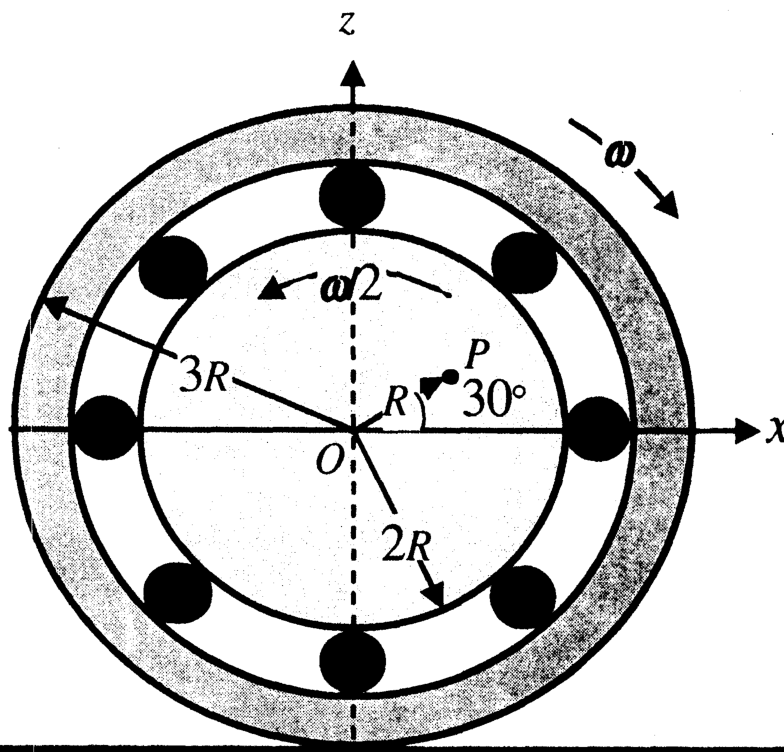
The diagram illustrates a setup comprising (i) a ring with outer radius rolling clockwise without slipping on a horizontal surface with angular speed , and (ii) an inner disc with radius rotating counter-clockwise with angular velocity . The ring and disc are isolated via frictionless ball bearings. The system resides in the plane. Point on the inner disc is located at distance from origin , with line making an angle of with the horizontal line. With respect to the horizontal surface,
Options
the point has a linear velocity .
the point has a linear velocity .
the point has a linear velocity .
the point has a linear velocity .
Step-by-Step Solution
To determine the correct options, we analyze the motion of the center of mass and the point in the given coordinate system.
1. Setup of Coordinate System
The system resides in the plane, where:
- is the unit vector pointing along the horizontal -axis (to the right).
- is the unit vector pointing along the vertical -axis (upwards).
According to the right-handed Cartesian coordinate system (), the unit vector points into the plane of the paper (+y-direction).
2. Linear Velocity of Point (Option A)
The outer ring has a radius of and rolls clockwise without slipping on the horizontal surface with an angular speed .
-
Clockwise rotation in the plane corresponds to an angular velocity vector directed into the page:
-
Since the ring undergoes pure rolling, the linear velocity of its center is:
Thus, Option A is correct.
3. Linear Velocity of Point (Options B, C, D)
Point is on the inner disc, located at a distance from the center , and the line makes an angle of with the horizontal line.
-
Position vector of point relative to :
-
Angular velocity of the inner disc: The inner disc rotates counter-clockwise with an angular speed of . Counter-clockwise rotation in the plane corresponds to an angular velocity vector directed out of the page:
-
Velocity of point relative to :
Using the cross product relations and :
-
Total (absolute) velocity of point with respect to the horizontal surface:
Thus, Option B is correct, while Options C and D are incorrect.
Conclusion
The correct options are A and B.