Vapour Pressure Deviation and Raoults Law Behavior for Binary Liquid Mixture
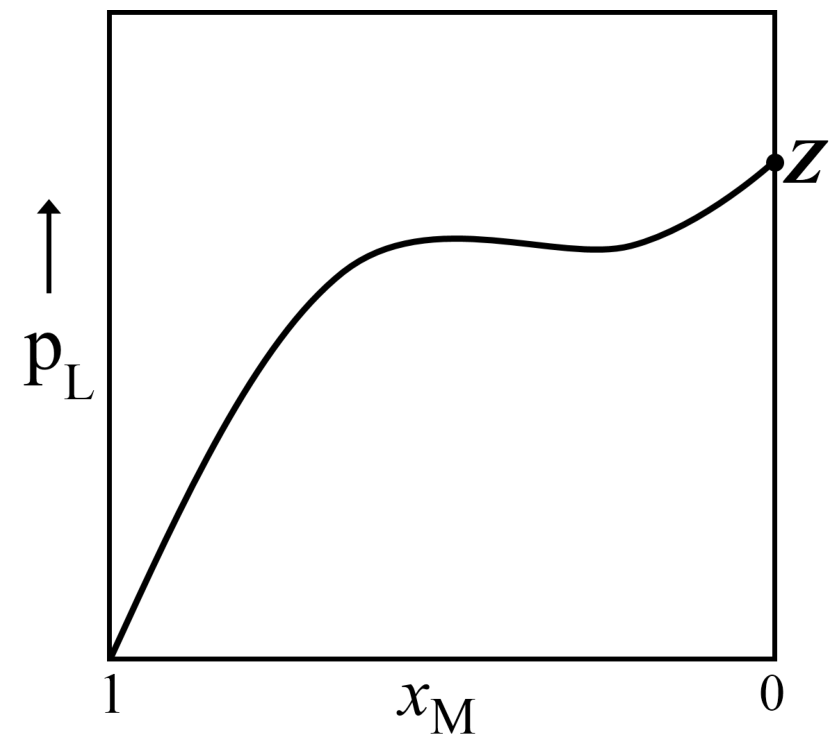
For a solution formed by mixing liquids and , the variation of vapour pressure of with respect to the mole fraction of in the solution phase is depicted in the figure. Here, and correspond to the mole fractions of and in the solution, respectively. Select the correct statement(s) applicable to this liquid mixture:
Options
Point signifies the vapour pressure of pure liquid and Raoult's law is obeyed from to
Point signifies the vapour pressure of pure liquid and Raoult's law is obeyed as
Point signifies the vapour pressure of pure liquid and Raoult's law is obeyed as
Intermolecular attractive interactions between in pure liquid and in pure liquid are stronger than interactions in the solution
Topics & Concepts
Step-by-Step Solution
To determine the correct statements regarding the given liquid mixture of and , we analyze the vapour pressure curve using thermodynamic principles and Raoult's law.
1. Analysis of Point and Raoult's Law Behavior
The given graph plots the partial vapour pressure of liquid () against the mole fraction of liquid ().
For a binary liquid mixture, the mole fractions of the two components are related by:
At point , the graph shows . Substituting this into the relation above gives:
- Since , point represents pure liquid , and the vapour pressure at corresponds to the vapour pressure of pure liquid , denoted as .
- According to Raoult's law, the partial vapour pressure of a component is given by:
- For any real solution, as the concentration of a component approaches purity (), its behavior approaches that of an ideal solution and obeys Raoult's law tangentially.
Therefore, Point signifies the vapour pressure of pure liquid , and Raoult's law is obeyed as . This makes Statement B correct and Statements A and C incorrect.
2. Intermolecular Forces and Deviation from Raoult's Law
For an ideal solution, the plot of versus would be a linear relationship given by:
In the provided curve:
- The graph lies above the ideal straight line connecting () and ().
- This upward curvature signifies a positive deviation from Raoult's law ().
A positive deviation occurs when molecules have a higher tendency to escape into the vapour phase than in an ideal solution. Physically, this means that the solute-solvent interactions () are weaker than the solute-solute () and solvent-solvent () interactions in the pure components:
Therefore, the intermolecular attractive forces between and in pure liquids are stronger than interactions in the solution. This makes Statement D correct.
Final Conclusion
The correct statements are B and D.