Trajectory of Charged Particle in Discontinuous Magnetic Field
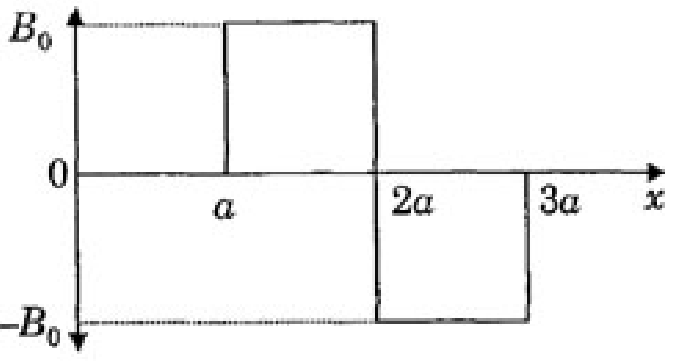
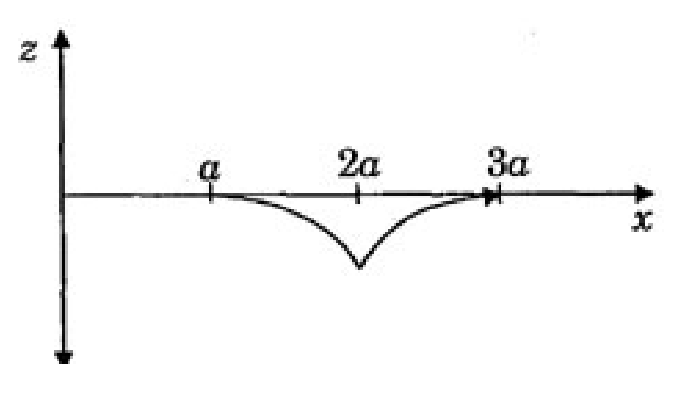
A magnetic field exists in the region and , in the region , where is a positive constant. A positive point charge moving with a velocity , where is a positive constant, enters the magnetic field at . The trajectory of the charge in this region can be like,
Options
Topics & Concepts
Step-by-Step Solution
To find the trajectory of the charged particle, we analyze the magnetic force acting on it in each region using the Lorentz force equation:
Given:
- Charge
- Initial velocity at is , where .
Region 1:
In this region, the magnetic field is:
The magnetic force acting on the particle just as it enters is:
- Since the force is directed along the positive -axis ( direction), the particle accelerates in the direction.
- The path is a circular arc in the plane with its center of curvature located at in the plane, where .
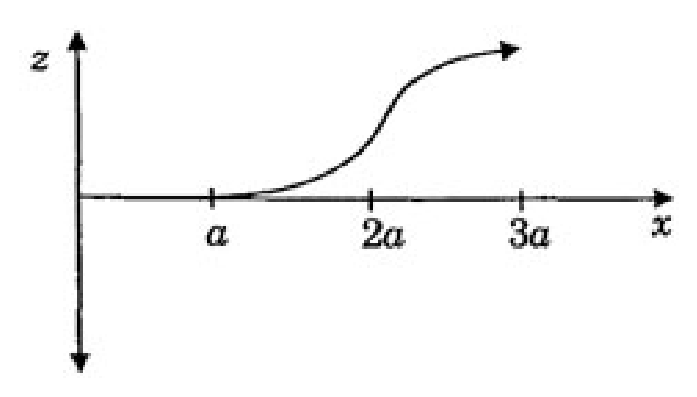
- As the particle progresses from to , its -coordinate increases (), and the slope increases from (the curve is concave upwards, ).
Region 2:
In this region, the magnetic field reverses direction:
The particle enters this region at with a velocity having components:
The magnetic force becomes:
- The -component of the acceleration is now negative:
- This implies that the curvature of the trajectory reverses, making the curve concave downwards ().
- Since the velocity vector is continuous, the slope remains smooth at (an inflection point), and the particle continues to move in the positive -direction while bending towards the horizontal.
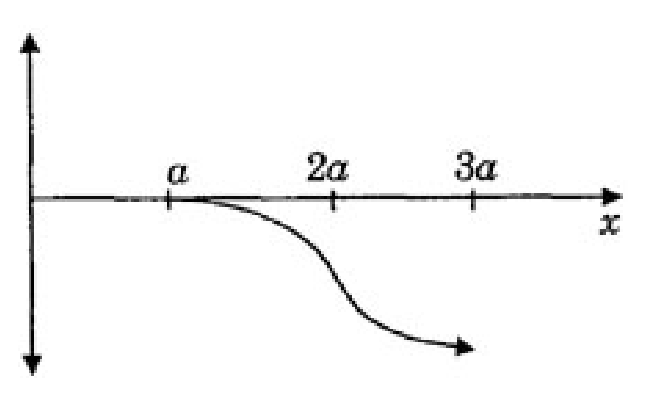
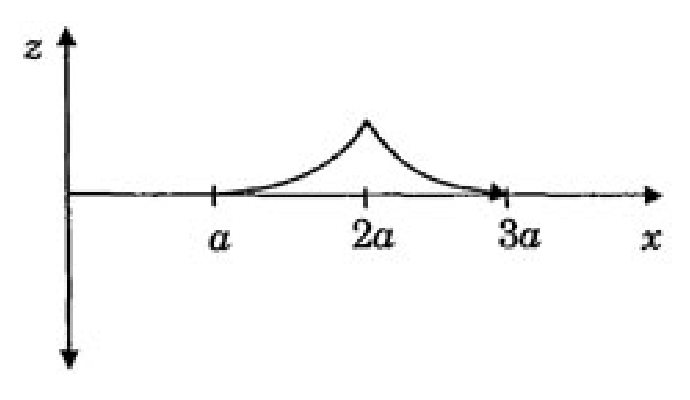
Comparing this behavior with the given options, the trajectory starts at tangent to the -axis, curves upward (concave up) until , and then continues upward with opposite curvature (concave down) until . This corresponds to the curve shown in graph (A).
Correct Answer: (A)