Total Number of Stereoisomers for Given Bicyclic Ketone Structure
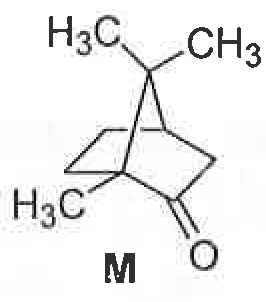
Calculate the total count of stereoisomers that can exist for the compound M shown below:
Official Numerical Answer2
Topics & Concepts
Step-by-Step Solution
To determine the total number of stereoisomers for compound M (camphor, 1,7,7-trimethylbicyclo[2.2.1]heptan-2-one), we analyze its molecular structure and stereochemical constraints:
-
Identification of Chiral (Stereogenic) Centers:
- Carbon-1 (): A bridgehead carbon atom bonded to four different groups/pathways:
- A methyl group ()
- The bridge group ()
- The carbonyl carbon ()
- The methylene carbon ()
- Carbon-4 (): A bridgehead carbon atom bonded to four different groups/pathways:
- A hydrogen atom ()
- The bridge group ()
- (adjacent to the carbonyl group)
- (adjacent to )
- Carbon-1 (): A bridgehead carbon atom bonded to four different groups/pathways:
-
Structural and Geometrical Constraints of Bicyclo[2.2.1]heptane:
- The bicyclo[2.2.1]heptane system is extremely rigid.
- The one-carbon bridge () must span the two bridgehead carbons ( and ) in a cis-fused manner. A trans-bridgehead arrangement in a small bicyclic ring system like bicyclo[2.2.1] heptane is geometrically impossible due to severe ring strain.
- Consequently, the relative configurations of and are locked together; independent inversion at only one bridgehead carbon to form diastereomers cannot occur.
-
Calculation of Stereoisomers:
- Inverting the absolute configurations at both bridgehead centers simultaneously () generates the non-superimposable mirror image (enantiomer).
- No diastereomers are structurally viable.
Therefore, the total number of stereoisomers that can exist for compound M is 2 (one pair of enantiomers: -camphor and -camphor).