Total Number of Optically Active Stereoisomers for Compound X
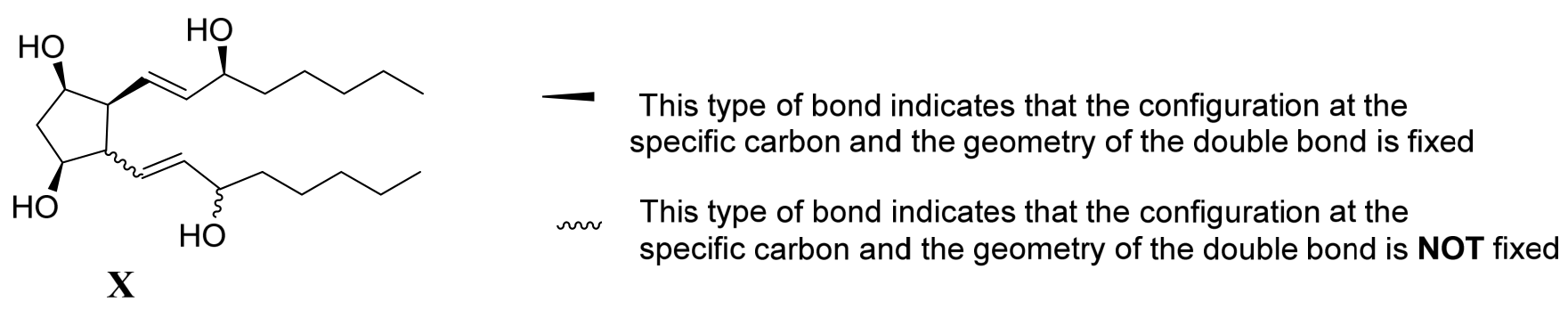
For the given compound , determine the total number of optically active stereoisomers.
Topics & Concepts
Step-by-Step Solution
To determine the total number of optically active stereoisomers for compound , we analyze the fixed and variable stereogenic units present in its structure.
1. Analysis of Stereogenic Units
-
Fixed stereocenters and double bonds (represented by solid wedges/thick bonds):
- The two groups on the cyclopentane ring are fixed in their configurations (both represented by solid wedges).
- The upper side chain has:
- A fixed double bond geometry (-configuration / trans).
- A fixed stereocenter at the carbon attached to the upper group (solid wedge).
-
Variable stereogenic units (represented by wavy lines):
- The stereocenter at the cyclopentane ring carbon attached to the lower side chain (2 choices: or ).
- The double bond geometry in the lower side chain (2 choices: or ).
- The stereocenter at the lower side chain carbon attached to the group (2 choices: or ).
2. Calculation of Total Stereoisomers
Since there are independent variable stereogenic units, the total number of stereoisomers generated is:
3. Determination of Optically Active Stereoisomers
The cyclopentane core containing the two identical ring groups with fixed, identical configurations possesses a potential internal plane of symmetry () passing through the isolated ring group and bisecting the bond between the two chain-bearing ring carbons.
-
Meso Compound (Optically Inactive): Out of the possible configurations for the lower chain, exactly configuration matches the stereochemistry of the upper chain such that the molecule possesses a plane of symmetry. This single stereoisomer is a meso compound and is optically inactive.
-
Optically Active Stereoisomers: The remaining stereoisomers lack any plane of symmetry or inversion center, making them chiral and optically active.