Total Number of Carbonyl Groups in Decarboxylation Products
The sum of total number of carbonyl groups () present in the major products and in the following reactions is _____.
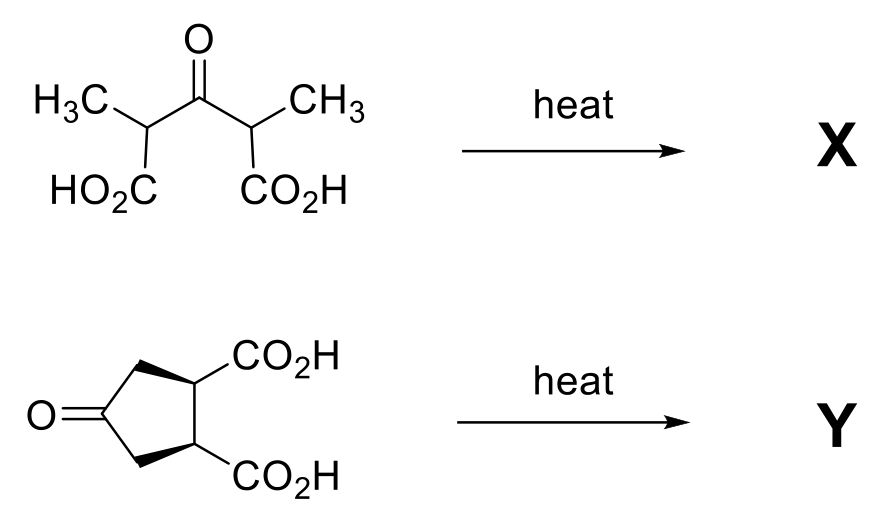
Step-by-Step Solution
To find the sum of the total number of carbonyl groups () present in the major products and , we analyze both thermal reactions step-by-step:
Reaction 1: Formation of Product
-
Reactant Analysis: The reactant is : This compound is a -ketodicarboxylic acid, where both carboxylic acid () groups are in a -position relative to the central carbonyl group ().
-
Reaction Mechanism: -keto carboxylic acids readily undergo thermal decarboxylation via a six-membered cyclic transition state upon heating to lose carbon dioxide (). Since both carboxylic acid groups are at -positions, complete decarboxylation occurs twice:
-
Product : The major product is pentan-3-one ().
- Number of carbonyl groups () in (the ketone group).
Reaction 2: Formation of Product
-
Reactant Analysis: The reactant is . The two carboxylic acid () groups are attached to adjacent carbon atoms (-position) in a -orientation, forming a succinic acid moiety on the cyclopentanone ring.
-
Reaction Mechanism: When a -dicarboxylic acid (succinic acid derivative) is heated, intramolecular dehydration (loss of ) takes precedence over decarboxylation, leading to the formation of a stable -membered cyclic anhydride ring fused to the cyclopentanone core:
-
Product : The major product is a bicyclic keto-anhydride (tetrahydro--cyclopentafuran--trione).
- Number of carbonyl groups () in ( ring ketone carbonyl group anhydride carbonyl groups).
Conclusion:
- Total carbonyl groups in
- Total carbonyl groups in