Total Carboxylic Acid Groups in Product P
Determine the total count of carboxylic acid functional groups present in the final product obtained from the sequence of reactions shown below:
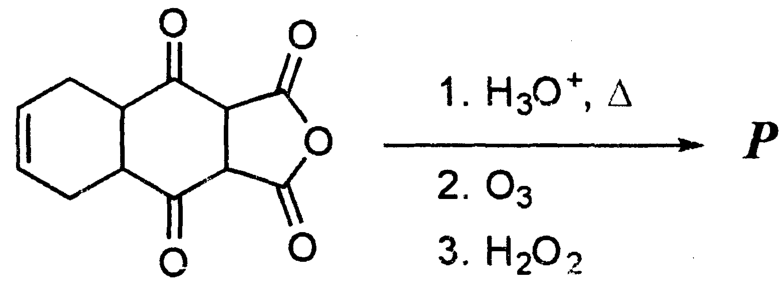
Step-by-Step Solution
To determine the total count of carboxylic acid functional groups present in the final product , we analyze the reaction sequence step-by-step:
Step 1: Acidic Hydrolysis and Heating ()
-
Hydrolysis of the Anhydride: The starting material contains a cyclic anhydride functional group fused to a diketone system. Treatment with hydronium ions () hydrolyzes the cyclic anhydride ring to give two carboxylic acid functional groups ().
-
Decarboxylation of -Keto Acids: In the hydrolyzed intermediate, each newly formed carboxylic acid group is located at a position to a ketone carbonyl group ().
-keto acids are thermally unstable and readily undergo decarboxylation upon heating () via a six-membered cyclic transition state:
Since both groups are to ketone carbonyls, heating causes both carboxylic acid groups to be lost as two molecules of . Thus, after Step 1, no carboxylic acid functional groups remain in the intermediate diketone.
Steps 2 & 3: Oxidative Ozonolysis ( followed by )
-
Cleavage of the Alkene Double Bond: The intermediate obtained from Step 1 contains one carbon-carbon double bond () within its cyclohexene ring.
-
Oxidation to Carboxylic Acids: Reaction with ozone () followed by oxidative workup with hydrogen peroxide () oxidatively cleaves the double bond. Each carbon of the double bond is oxidized to a carboxylic acid group ():
-
The ketone carbonyl groups present in the bicyclic core remain unreactive under these conditions.
Conclusion
The oxidative ozonolysis of the single double bond in the cyclohexene ring yields a open-chain dicarboxylic acid derivative containing exactly carboxylic acid groups ().
Therefore, the total count of carboxylic acid functional groups present in product is 2.