Total Bromine Atoms in Compound T Synthesis Scheme
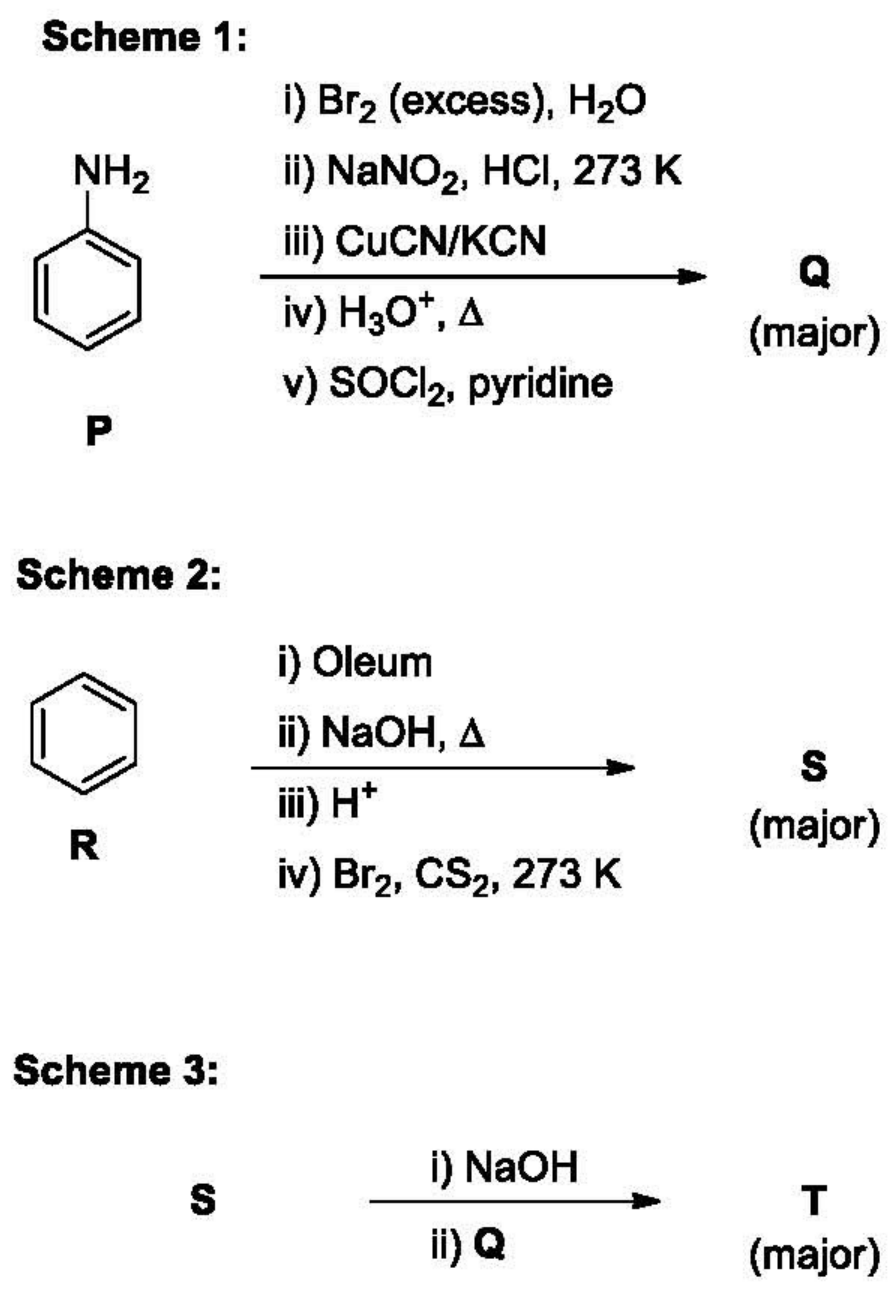
Schemes 1 and 2 outline the reaction steps to yield from and from , respectively. Scheme 3 demonstrates the synthesis of product using and . Determine the overall number of atoms contained in one molecule of .
Official Numerical Answer4
Topics & Concepts
Step-by-Step Solution
To determine the total number of bromine () atoms in one molecule of compound , we trace the step-by-step chemical transformations in each scheme:
Scheme 1: Synthesis of Compound
- Reactant : Aniline ().
- Step (i): Reaction with
- The amino group () is strongly activating, and in aqueous medium, it undergoes electrophilic aromatic substitution to form 2,4,6-tribromoaniline (contains Br atoms).
- Step (ii): Reaction with
- Diazotization converts the group to a diazonium salt, yielding 2,4,6-tribromobenzenediazonium chloride.
- Step (iii): Reaction with
- Sandmeyer reaction replaces the diazonium group () with a cyano group (), forming 2,4,6-tribromobenzonitrile.
- Step (iv): Reaction with
- Acid hydrolysis converts the cyano group () into a carboxylic acid group (), yielding 2,4,6-tribromobenzoic acid.
- Step (v): Reaction with
- Chlorination converts the carboxylic acid into an acyl chloride, yielding 2,4,6-tribromobenzoyl chloride as the major product .
Number of atoms in compound
Scheme 2: Synthesis of Compound
- Reactant : Benzene ().
- Step (i): Reaction with
- Sulfonation yields benzenesulfonic acid ().
- Steps (ii) & (iii): Reaction with followed by
- Alkali fusion followed by acidification converts benzenesulfonic acid to phenol ().
- Step (iv): Reaction with
- Electrophilic bromination of phenol in a non-polar solvent () at low temperature selectively yields 4-bromophenol (para-bromophenol) as the major product .
Number of atoms in compound
Scheme 3: Synthesis of Compound
- Step (i): Reaction of (4-bromophenol) with
- Deprotonation forms sodium 4-bromophenoxide.
- Step (ii): Reaction of sodium 4-bromophenoxide with (2,4,6-tribromobenzoyl chloride)
- Nucleophilic acyl substitution results in the formation of an ester, 4-bromophenyl 2,4,6-tribromobenzoate as the major product .
Conclusion:
Compound consists of:
- bromine atoms from the 2,4,6-tribromobenzoyl moiety ()
- bromine atom from the 4-bromophenoxy moiety ()