Time Taken for Block to Slide Down Moving Wedge
A wedge with mass of and all frictionless surfaces and the inclined surface making with horizontal. A block with mass is placed at the highest point of the wedge as shown in figure is at rest. At wedge () is pulled toward right with constant force () of . Taking the block at rest at , the time taken by it to slide down on the slope, while is on the move, is ______ s. (take and )
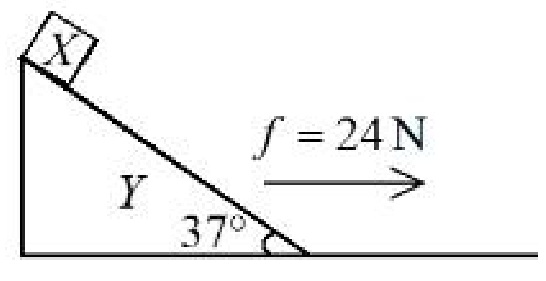
Options
Topics & Concepts
Step-by-Step Solution
To find the time taken by block to slide down the wedge , we analyze the motion of the system using Newton's laws of motion.
1. Given Data
- Mass of wedge ,
- Mass of block ,
- Pulling force,
- Angle of inclination,
- Distance to slide along the slope,
- Acceleration due to gravity,
2. Horizontal Acceleration of the Wedge System
The total horizontal force acts on the system consisting of the wedge and the block. The horizontal acceleration of the system is given by:
Substituting the given values:
3. Motion of Block Relative to Wedge
In the non-inertial reference frame of the accelerating wedge :
-
The component of acceleration due to gravity along the inclined plane (downwards) is:
-
Since the wedge accelerates to the right with acceleration , block experiences a pseudo acceleration of to the left. The component of this pseudo acceleration opposing the motion down the incline is:
Thus, the net relative acceleration of block sliding down the incline is:
4. Calculation of Time Taken
Using the kinematic equation for motion along the incline with initial relative velocity :
Substitute and :
Thus, the time taken by block to slide down on the slope is .