JEE Challenger
More from Mechanical Properties of Fluids

Time Period of Small Oscillations of Thin Rod in Immiscible Liquids

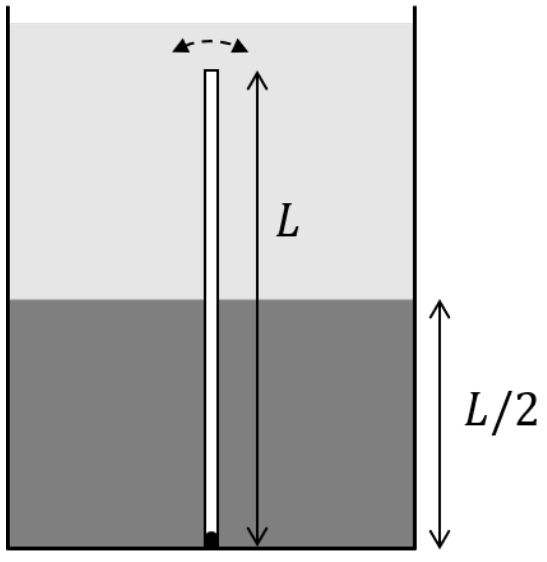
A tank contains two immiscible liquids of densities 6ρ6\rho and 2ρ2\rho. The higher density liquid is filled up to a height L/2L/2 from the bottom. A thin rod of density ρ\rho and length LL is fully immersed and hinged at the bottom so that it can oscillate freely, as shown in the figure. If the rod is slightly disturbed from its equilibrium, the time period of small oscillations is 2πnLg\frac{2\pi}{n}\sqrt{\frac{L}{g}}, where gg is the acceleration due to gravity. The value of nn is:

Question Diagram 1
Official Numerical Answer1.7 to 1.75

Step-by-Step Solution

To find the time period of small oscillations of the thin rod hinged at the bottom, we analyze the torques acting on the rod when it is displaced by a small angle θ\theta from its vertical equilibrium position.

1. Forces and Torques Acting on the Rod

Let AA be the uniform cross-sectional area of the rod.

  • Weight of the rod (WW): The total mass of the rod is: M=ρALM = \rho A L The force of gravity acts vertically downwards at the center of mass of the rod, located at a distance L2\frac{L}{2} from the hinge along the rod.

    The torque due to gravity about the hinge attempts to increase θ\theta (destabilizing torque): τg=+Mg(L2)sinθρALg(L2)θ=12ρAL2gθ\tau_g = + M g \left(\frac{L}{2}\right) \sin\theta \approx \rho A L g \left(\frac{L}{2}\right) \theta = \frac{1}{2} \rho A L^2 g \theta

  • Buoyant force from Liquid 1 (bottom half, 0yL/20 \le y \le L/2): The density of Liquid 1 is 6ρ6\rho. The volume of this segment is A(L2)A \left(\frac{L}{2}\right). The buoyant force is: FB1=(6ρ)A(L2)g=3ρALgF_{B1} = (6\rho) A \left(\frac{L}{2}\right) g = 3 \rho A L g This force acts vertically upwards at the center of this segment, which is at a distance L4\frac{L}{4} from the hinge.

    The torque due to FB1F_{B1} about the hinge acts to restore the rod to the vertical position: τB1=FB1(L4)sinθ(3ρALg)(L4)θ=34ρAL2gθ\tau_{B1} = - F_{B1} \left(\frac{L}{4}\right) \sin\theta \approx - (3 \rho A L g) \left(\frac{L}{4}\right) \theta = -\frac{3}{4} \rho A L^2 g \theta

  • Buoyant force from Liquid 2 (top half, L/2yLL/2 \le y \le L): The density of Liquid 2 is 2ρ2\rho. The volume of this segment is A(L2)A \left(\frac{L}{2}\right). The buoyant force is: FB2=(2ρ)A(L2)g=ρALgF_{B2} = (2\rho) A \left(\frac{L}{2}\right) g = \rho A L g This force acts vertically upwards at the center of this segment, which is at a distance L2+L4=3L4\frac{L}{2} + \frac{L}{4} = \frac{3L}{4} from the hinge.

    The torque due to FB2F_{B2} about the hinge acts to restore the rod: τB2=FB2(3L4)sinθ(ρALg)(3L4)θ=34ρAL2gθ\tau_{B2} = - F_{B2} \left(\frac{3L}{4}\right) \sin\theta \approx - (\rho A L g) \left(\frac{3L}{4}\right) \theta = -\frac{3}{4} \rho A L^2 g \theta


2. Net Restoring Torque and Equation of Motion

The net torque about the hinge is given by: τnet=τg+τB1+τB2\tau_{\text{net}} = \tau_g + \tau_{B1} + \tau_{B2} τnet=(12ρAL2g34ρAL2g34ρAL2g)θ\tau_{\text{net}} = \left( \frac{1}{2} \rho A L^2 g - \frac{3}{4} \rho A L^2 g - \frac{3}{4} \rho A L^2 g \right) \theta τnet=(1264)ρAL2gθ=ρAL2gθ\tau_{\text{net}} = \left( \frac{1}{2} - \frac{6}{4} \right) \rho A L^2 g \theta = - \rho A L^2 g \theta

The moment of inertia of the thin rod about the hinge at one of its ends is: I=13ML2=13(ρAL)L2=13ρAL3I = \frac{1}{3} M L^2 = \frac{1}{3} (\rho A L) L^2 = \frac{1}{3} \rho A L^3

Using Newton's second law for rotation, Iθ¨=τnetI \ddot{\theta} = \tau_{\text{net}}: 13ρAL3θ¨=ρAL2gθ\frac{1}{3} \rho A L^3 \ddot{\theta} = -\rho A L^2 g \theta θ¨+3gLθ=0\ddot{\theta} + \frac{3g}{L} \theta = 0


3. Time Period of Oscillations

This equation is of the standard simple harmonic motion (SHM) form θ¨+ω2θ=0\ddot{\theta} + \omega^2 \theta = 0, where: ω=3gL\omega = \sqrt{\frac{3g}{L}}

The time period of small oscillations TT is: T=2πω=2π3gL=2π3LgT = \frac{2\pi}{\omega} = \frac{2\pi}{\sqrt{\frac{3g}{L}}} = \frac{2\pi}{\sqrt{3}} \sqrt{\frac{L}{g}}

Comparing this with the given expression T=2πnLgT = \frac{2\pi}{n} \sqrt{\frac{L}{g}}, we get: n=31.732n = \sqrt{3} \approx 1.732

Thus, the value of nn is 1.73\mathbf{1.73} (or 3\sqrt{3}).

Time Period of Small Oscillations of Thin Rod in Immiscible Liquids | Physics PYQ Solution - JEE Challenger