Time Period of Oscillations of Uniform Disc About Axis
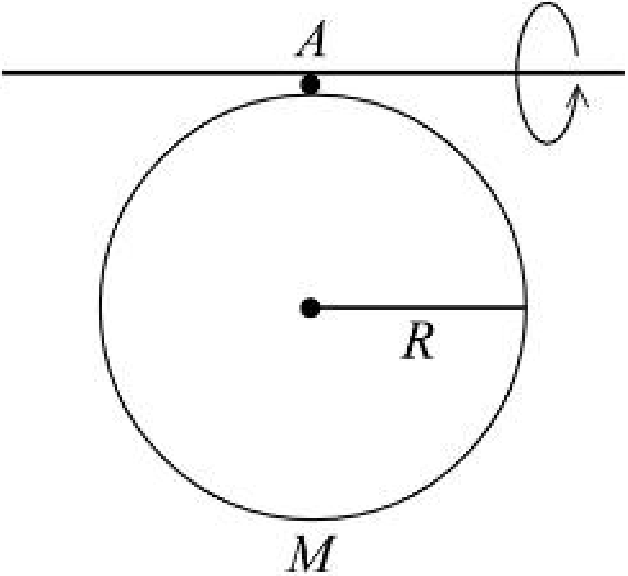
A uniform disc of radius and mass is free to oscillate about the axis as shown in the figure. For small oscillations the time period is _________. ( is acceleration due to gravity)
Options
A
Correct
B
C
D
Topics & Concepts
Step-by-Step Solution
To find the time period of small oscillations of the uniform disc about the given axis :
-
Identify the axis of rotation and Moment of Inertia ():
- The axis is a tangent to the circular disc, lying in the plane of the disc at its top point.
- The moment of inertia of a uniform disc of mass and radius about its diameter (an axis passing through its center of mass and lying in its plane) is:
- The distance from the center of mass to the axis is .
- By the parallel axis theorem, the moment of inertia about axis is:
-
Equation of Motion for Small Oscillations:
- When the disc is displaced by a small angle from its equilibrium position, the restoring torque about axis due to gravity acting at the center of mass is:
- For small angles ():
- Using Newton's second law for rotation ():
-
Time Period Calculation:
- The angular frequency of small oscillations is:
- Therefore, the time period of oscillations is given by:
This corresponds to Option A.