JEE Challenger
More from Electrostatic Potential and Capacitance

Time for Voltage Across Parallel Capacitors in RC Circuit

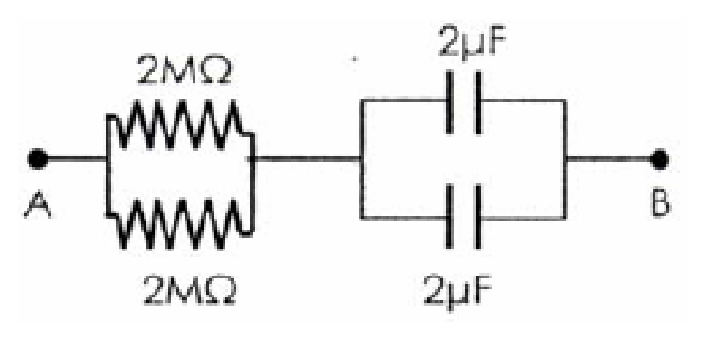
At time t=0t = 0, a battery of 10 V10\text{ V} is connected across points A and B in the given circuit. If the capacitors have no charge initially, at what time (in seconds) does the voltage across them become 4 V4\text{ V} ?

Diagram 0

[Take : ln⁡5=1.6\ln 5 = 1.6, ln⁡3=1.1\ln 3 = 1.1]

Official Numerical Answer2

Step-by-Step Solution

To find the time at which the voltage across the capacitors becomes 4 V4\text{ V}, we first simplify the given circuit by finding the equivalent resistance and equivalent capacitance.

Step 1: Equivalent Resistance (ReqR_{\text{eq}})

The two resistors, each of resistance R=2 MΩR = 2\text{ M}\Omega, are connected in parallel. Their equivalent resistance is:
Req=2 MΩ2=1 MΩ=106 ΩR_{\text{eq}} = \frac{2\text{ M}\Omega}{2} = 1\text{ M}\Omega = 10^6\ \Omega

Step 2: Equivalent Capacitance (CeqC_{\text{eq}})

The two capacitors, each of capacitance C=2 μFC = 2\ \mu\text{F}, are connected in parallel. Their equivalent capacitance is:
Ceq=2 μF+2 μF=4 μF=4×10⁻⁶ FC_{\text{eq}} = 2\ \mu\text{F} + 2\ \mu\text{F} = 4\ \mu\text{F} = 4 \times 10^{-6}\ \text{F}

Step 3: Time Constant (τ\tau)

The time constant of the equivalent RCRC circuit is:
τ=ReqCeq=(106 Ω)×(4×10⁻⁶ F)=4 seconds\tau = R_{\text{eq}} C_{\text{eq}} = (10^6\ \Omega) \times (4 \times 10^{-6}\ \text{F}) = 4\text{ seconds}

Step 4: Voltage across the Capacitors as a Function of Time

The charging equation for the voltage V(t)V(t) across the parallel combination of capacitors connected to a battery of V0=10 VV_0 = 10\text{ V} is given by:
V(t)=V0(1−e−t/τ)V(t) = V_0 \left(1 - e^{-t/\tau}\right)

Substitute V(t)=4 VV(t) = 4\text{ V}, V0=10 VV_0 = 10\text{ V}, and τ=4 s\tau = 4\text{ s}:
4=10(1−e−t/4)4 = 10 \left(1 - e^{-t/4}\right)

Divide both sides by 1010:
0.4=1−e−t/40.4 = 1 - e^{-t/4}
e−t/4=0.6=35e^{-t/4} = 0.6 = \frac{3}{5}

Taking the reciprocal of both sides gives:
et/4=53e^{t/4} = \frac{5}{3}

Step 5: Solving for tt

Taking the natural logarithm on both sides:
t4=ln⁡(53)=ln⁡5−ln⁡3\frac{t}{4} = \ln\left(\frac{5}{3}\right) = \ln 5 - \ln 3

Using the given values ln⁡5=1.6\ln 5 = 1.6 and ln⁡3=1.1\ln 3 = 1.1:
t4=1.6−1.1=0.5\frac{t}{4} = 1.6 - 1.1 = 0.5

t=4×0.5=2 secondst = 4 \times 0.5 = 2\text{ seconds}